
What Is the Behavioral Portfolio Theory?

Traditional financial theory assumes that investors are purely rational beings who always make logical choices to maximize wealth while minimizing risk. Modern Portfolio Theory (MPT), developed by Harry Markowitz in the 1950s, tells us to build diversified portfolios based strictly on expected returns and mathematical variance.
However, if you have ever panicked during a stock market crash, held onto a losing stock because you couldn’t bear to admit defeat, or kept your retirement savings in a completely separate bucket from your vacation money, you know the truth: humans are not rational calculators.
This realization led behavioral economists Hersh Shefrin and Meir Statman to develop Behavioral Portfolio Theory (BPT).
What Is Behavioral Portfolio Theory?
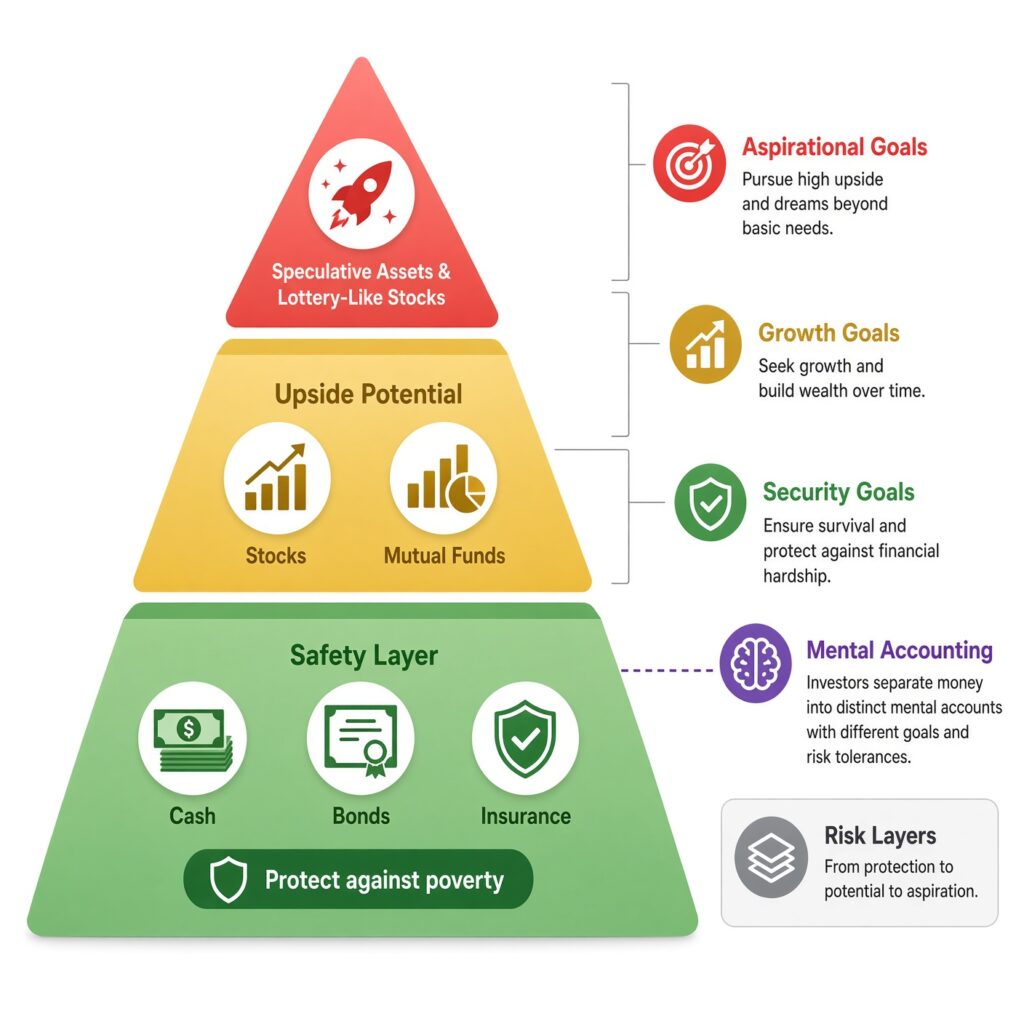
Behavioral Portfolio Theory is an investment framework that explains how real people actually build and manage their portfolios, taking into account their psychological biases, emotional needs, and personal goals.
Unlike traditional portfolio theory—which views an investment portfolio as a single, unified pool of assets optimized on a spreadsheet—Behavioral Portfolio Theory views a portfolio much like a pyramid of mental accounts.
When using a behavioral approach, investors do not just look at the overall risk and return of their entire net worth. Instead, they divide their money into distinct mental buckets or layers, assigning different goals, risk tolerances, and emotional attachments to each layer.
- The Lower Layer (Protection): Money dedicated to preventing poverty, securing basic needs, or avoiding catastrophic loss. Investors here are extremely risk-averse.
- The Upper Layer (Aspiration): Money dedicated to hitting big financial home runs, such as buying a dream house, retiring early, or striking it rich with high-growth assets. Investors here are willing to take extreme risks.
Why Traditional Portfolio Theory Fails Real Investors
To understand why Behavioral Portfolio Theory matters, we need to look at why the traditional model often breaks down in the real world.
Modern Portfolio Theory works brilliantly on paper. It teaches the value of diversification and asset allocation. But it makes a fatal assumption: that investors care only about the final, aggregate wealth of their entire portfolio.
In reality, investors suffer from mental accounting. We treat dollars differently depending on where they came from or what we intend to use them for. For example:
- Windfalls vs. Hard-Earned Cash: People are much more likely to gamble away a tax refund or casino winnings than money earned through a weekly paycheck.
- Loss Aversion: Psychologically, the pain of losing one dollar is twice as intense as the joy of making one dollar. Because of this, traditional diversification advice often fails because investors refuse to sell losing assets or panic during market downturns.
Behavioral Portfolio Theory bridges the gap between economic theory and human psychology by acknowledging these exact behaviors.
The Pyramid Structure of Behavioral Portfolio Theory
In Hersh Shefrin and Meir Statman’s original formulation, the behavioral portfolio resembles a pyramid. Each layer serves a specific emotional and financial purpose.
      /\
     /  \   Upper Layer: High Aspiration (Crypto, Speculative Stocks)
    /----\
   /      \ Middle Layer: Moderate Growth (Balanced Funds, Blue Chips)
  /--------\
 /          \ Lower Layer: Downside Protection (Cash, Treasury Bonds, Insurance)
------------------------------------------------------------------------
1. The Lower Layer: Downside Protection and Security
At the base of the pyramid is the security layer. The primary goal here is not to get rich, but to avoid becoming poor.
Investors allocate funds to assets that provide absolute downside protection. This includes emergency cash reserves, government bonds, safe certificates of deposit, and insurance policies. Even if the upper layers of the portfolio crash and burn, the investor knows their fundamental survival needs are secure.
2. The Middle Layers: Moderate Growth and Income
As we move up the pyramid, investors allocate money toward maintaining or improving their standard of living. This layer typically contains blue-chip dividend-paying stocks, broad-market index funds, and real estate investments. The goal here is steady, reliable compounding over time.
3. The Top Layer: High Aspiration and Wealth Transformation
At the very peak of the pyramid sits the aspiration layer. This is where investors take concentrated bets in pursuit of life-changing wealth.
People allocate a small, controlled percentage of their net worth to high-risk, high-reward opportunities, such as speculative technology stocks, initial public offerings (IPOs), cryptocurrencies, or options trading.
Crucially, Behavioral Portfolio Theory suggests that allocating money to this top layer can actually prevent investors from making reckless choices with their core savings. By satisfying the psychological craving for excitement in a designated, ring-fenced bucket, investors are less likely to gamble with their retirement funds.
Key Psychological Concepts Behind Behavioral Portfolio Theory
To fully grasp how BPT operates in everyday financial decision-making, it helps to understand the core psychological pillars supporting it.
Prospect Theory and Loss Aversion
Pioneered by psychologists Daniel Kahneman and Amos Tversky, Prospect Theory proved that people evaluate gains and losses relative to a specific reference point rather than final wealth outcomes.
Because losses hurt so much more than gains feel good, investors frequently exhibit the Disposition Effect: the tendency to sell winning investments too early to lock in a good feeling, while holding onto losing investments indefinitely in the hope that prices will bounce back to even.
Mental Accounting
Mental accounting is the cognitive process through which individuals categorize financial transactions, assets, and goals into separate mental compartments. While financial advisors often preach that “money is fungible” (every dollar spends the same), human beings naturally violate this rule every single day.
Recognizing mental accounting allows behavioral finance practitioners to work with human nature rather than fighting a losing battle against it.
The Desire for Downside Protection vs. Lottery Tickets
Behavioral research shows that humans have a simultaneous desire for safety and skewness (the chance of a massive payout). This explains why people buy lottery tickets while also holding money in insured savings accounts. Behavioral Portfolio Theory incorporates this exact duality into portfolio construction.
Behavioral Portfolio Theory vs. Modern Portfolio Theory (Comparison Table)
| Feature | Modern Portfolio Theory (MPT) | Behavioral Portfolio Theory (BPT) |
|---|---|---|
| Core Assumption | Investors are completely rational and risk-averse. | Investors are emotional, prone to biases, and have multiple goals. |
| View of Wealth | Viewed as a single, unified pool of assets. | Viewed through “mental accounts” split into separate layers. |
| Risk Measurement | Measured mathematically as variance or standard deviation of returns. | Measured as the probability of failing to reach specific personal goals. |
| Diversification | Optimized strictly along an efficient frontier curve. | Built like a pyramid to satisfy emotional safety and aspiration needs. |
| Handling of Losses | Balanced mathematically across the entire portfolio. | Governed by loss aversion and mental boundaries between buckets. |
Practical Applications: How to Build Your Own Behavioral Portfolio
Understanding theory is valuable, but applying it to your personal finances is where the magic happens. You can use the principles of Behavioral Portfolio Theory to design a resilient, stress-free investment strategy.
Step 1: Define Your True Financial Goals
Instead of just asking, “What rate of return do I want?” ask yourself:
- What money do I absolutely cannot afford to lose?
- What money is earmarked for comfortable living?
- What money am I willing to risk for extraordinary growth?
Step 2: Establish Your Security Foundation First
Before buying any volatile assets, fund your lower layer. Build a robust emergency fund covering three to six months of living expenses, pay down high-interest toxic debt, and ensure you have adequate insurance coverage. Knowing this foundation is rock-solid will dramatically reduce your financial anxiety.
Step 3: Allocate Core Growth Assets
In your middle layers, embrace low-cost, diversified index funds or established dividend growth stocks. This is your engine for long-term wealth accumulation that requires minimal active management.
Step 4: Create a “Play Money” Sandbox
If you have an irresistible itch to trade meme stocks, crypto tokens, or speculative startups, don’t suppress it entirely—allocate a strictly limited amount (e.g., 2% to 5% of your portfolio) to an aspiration layer. If you lose it, your financial future remains intact. If it moons, you celebrate a bonus victory.
Common Pitfalls and Criticisms of Behavioral Portfolio Theory

While Behavioral Portfolio Theory provides a deeply realistic look at investor psychology, financial researchers point out a few limitations:
- Lower Mathematical Efficiency: Because assets are segregated into rigid mental buckets, a behavioral portfolio may not sit on the strict mathematical “efficient frontier” of Modern Portfolio Theory. This means you might technically sacrifice a fraction of theoretical return in exchange for psychological peace of mind.
- Risk of Over-Diversification in Buckets: Investors can end up holding too many redundant funds across different mental accounts, driving up administrative complexity and potential fees.
- Subjectivity: Because mental accounting varies wildly from person to person, there is no universal mathematical formula for a behavioral portfolio that applies equally to everyone.
Mastering Your Mind to Grow Your Wealth
Investing is only 20% math and 80% behavior. You can have the most sophisticated asset allocation model in the world, but if your emotions cause you to panic-sell at the absolute market bottom, your spreadsheet intelligence will not save you.
Behavioral Portfolio Theory teaches us that effective wealth building isn’t about ignoring our human quirks—it is about designing a portfolio structure that accommodates them. By protecting your downside, stabilizing your core growth, and safely quarantining your speculative impulses, you can build a robust financial strategy that survives both market volatility and human nature.