What Is the Ostrich Effect in Personal Finance?

Have you ever avoided opening your bank statement because you were afraid of what you might see? Or perhaps you haven’t checked your investment portfolio in months during a market downturn, telling yourself that “what you don’t know can’t hurt you”?
If this sounds familiar, you are certainly not alone. Millions of people fall into a common psychological trap known in behavioral finance as the Ostrich Effect.
Just like the mythical belief that an ostrich buries its head in the sand to avoid danger, humans often choose to ignore negative financial information rather than face it. While this coping mechanism might provide temporary peace of mind, it almost always leads to long-term financial stress, missed opportunities, and mounting debt.
In this comprehensive guide, we will break down what the Ostrich Effect is, why our brains are wired this way, how it impacts your wallet, and—most importantly—actionable steps you can take to overcome it and take control of your financial future.
Understanding the Ostrich Effect: The Psychology Behind Financial Avoidance
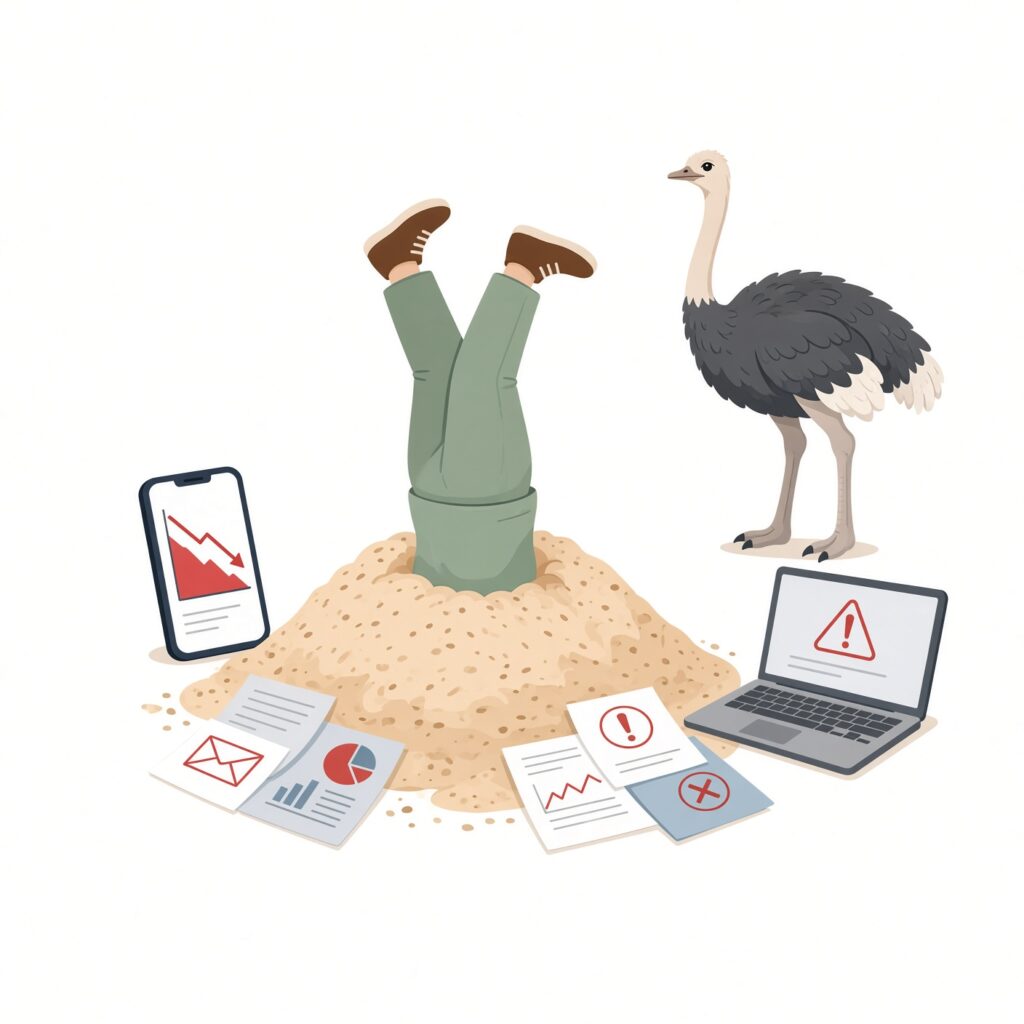
The Ostrich Effect is a cognitive bias where individuals deliberately avoid negative information—particularly financial data—assuming that if they ignore the problem, it will simply go away.
Coined by behavioral economists George Loewenstein, Ted O’Donoghue, and Matthew Rabin, this phenomenon highlights the gap between rational economic theory and actual human behavior. Traditional finance assumes that human beings are entirely rational agents who constantly seek out and analyze all available data to maximize their wealth. Behavioral finance, however, proves that human emotions, fears, and cognitive shortcuts frequently override pure logic.
When faced with potential bad news—such as credit card bills, plunging stock values, or overspent monthly budgets—our brains trigger a “fight or flight” response. Avoidance acts as a psychological defense mechanism designed to protect our self-esteem and reduce immediate anxiety. Unfortunately, while ignoring a physical threat might occasionally work, ignoring a financial threat only allows it to compound.
Why Do We Do It? The Core Drivers of Financial Denial
To conquer the Ostrich Effect, it helps to understand why we fall victim to it in the first place. Our financial habits are deeply tied to our emotions, self-worth, and evolutionary biology.
1. Fear of Negative Emotions and Shame
Money is one of the most emotionally charged topics in modern society. Many people tie their personal self-worth to their net worth. When a bank account balance is lower than expected or debt is piling up, looking at the numbers feels like a direct confrontation with personal failure. Avoidance shields us from experiencing shame, guilt, and anxiety.
2. Cognitive Dissonance and Self-Identity
Cognitive dissonance occurs when your actions and beliefs clash. If you view yourself as a smart, responsible person, seeing a massive credit card statement creates uncomfortable mental friction. Instead of updating your beliefs or changing your habits, your brain takes the easier route: pretending the statement doesn’t exist.
3. Present Bias and Instant Gratification
Human brains are evolutionarily wired to prioritize immediate rewards over long-term stability—a trait known as present bias. Checking your budget or logging into your retirement account forces you to confront the future and make sacrifices today. Ignoring your finances allows you to live in blissful, short-term ignorance.
Real-World Examples of the Ostrich Effect in Daily Life
The Ostrich Effect manifests differently depending on your financial situation. Here are the most common scenarios where financial avoidance creeps in:
- The Investment Portfolio Blackout: During a stock market correction or bear market, investors often stop logging into their brokerage accounts. Fearing the sight of red numbers, they miss out on rebalancing opportunities or panic-sell at the worst possible time later.
- The Unopened Mail Pile: Stacking bills on the counter and leaving them in envelopes because opening them makes the debt feel “real.”
- Ignoring Credit Card Statements: Swiping plastic without tracking purchases until the bill arrives, then choosing to pay only the minimum—or avoiding looking at the total balance altogether.
- Subscription Creep Blindness: Continuing to pay for unused streaming services, gym memberships, and software subscriptions simply because checking bank statements requires logging in and doing administrative work.
The Hidden Costs of Financial Avoidance
While turning a blind eye feels comforting in the short term, the financial toll of the Ostrich Effect is severe.
When you ignore your finances, small problems snowball into major crises. A neglected credit card balance accumulates high-interest debt that can take years to pay off. An unchecked investment strategy can drift into high-risk allocations without your knowledge. Furthermore, chronic financial avoidance creates lingering, low-grade anxiety that negatively affects your mental health, physical well-being, and relationships.
How to Overcome the Ostrich Effect and Take Control

Breaking free from financial avoidance requires patience, self-compassion, and structural changes to your routine. You cannot rely on willpower alone; you need to build systems that make facing your finances frictionless and safe.
1. Practice Self-Compassion and Drop the Shame
The first step to recovery is forgiving yourself for past financial mistakes. Everyone makes mistakes, overspends, or experiences periods of financial distress. Remind yourself that financial data is simply information—it is a dashboard, not a report card on your moral character.
2. Automate Your Finances to Reduce Friction
Automation is the ultimate antidote to the Ostrich Effect. By setting up automatic transfers for savings, investments, and bill payments, you remove the daily need to make painful financial decisions. Your systems work quietly in the background, keeping you secure even when you aren’t looking.
3. Schedule “Money Dates” with Yourself
Avoidance thrives in ambiguity. Combat this by scheduling regular, low-stress appointments with your money—such as a 20-minute review every Sunday morning. Pair your money date with something enjoyable, like your favorite coffee or playlist, to recondition your brain to associate financial reviews with positive experiences.
4. Break Tasks Down into Micro-Steps
Looking at your entire financial life at once can trigger paralysis. Instead, focus on micro-steps. Today, just open one banking app. Tomorrow, look at your retirement contribution rate. Small, manageable actions build momentum and reduce the fear of the unknown.
5. Enlist an Accountability Partner
It is much harder to hide from your finances when someone else is in the loop. Share your financial goals with a trusted partner, a close friend, or a fee-only financial planner. External accountability provides gentle encouragement and keeps you honest.
Embrace Transparency for Financial Freedom
The Ostrich Effect is a natural human tendency rooted in self-protection, but it is ultimately self-sabotaging. By understanding the psychological forces driving your financial avoidance, you can shift from a mindset of fear to one of empowerment.
Remember that financial health is a journey, not a destination. Every time you open a difficult bill, review a budget, or check an investment account, you are flexing your financial muscles and reducing the power that money anxiety holds over you. Stop hiding your head in the sand, embrace transparency, and build the secure financial future you deserve.