
Lump-Sum Investing vs. Dollar-Cost Averaging: Which Is Better?

When entering the financial markets or deploying a significant amount of capital, investors face a fundamental strategic question: Should you invest all your available funds at once, or should you divide the total sum into equal parts and invest them periodically over time?
This debate centers on two primary capital deployment strategies: Lump-Sum Investing (LSI) and Dollar-Cost Averaging (DCA). Both methodologies have distinct advantages, psychological trade-offs, and risk profiles. Understanding the nuances of each strategy allows investors to align their portfolio management with their risk tolerance, financial goals, and market expectations.
Understanding Lump-Sum Investing and Dollar-Cost Averaging
Before comparing performance, it is essential to define how each strategy operates in real-world market environments.
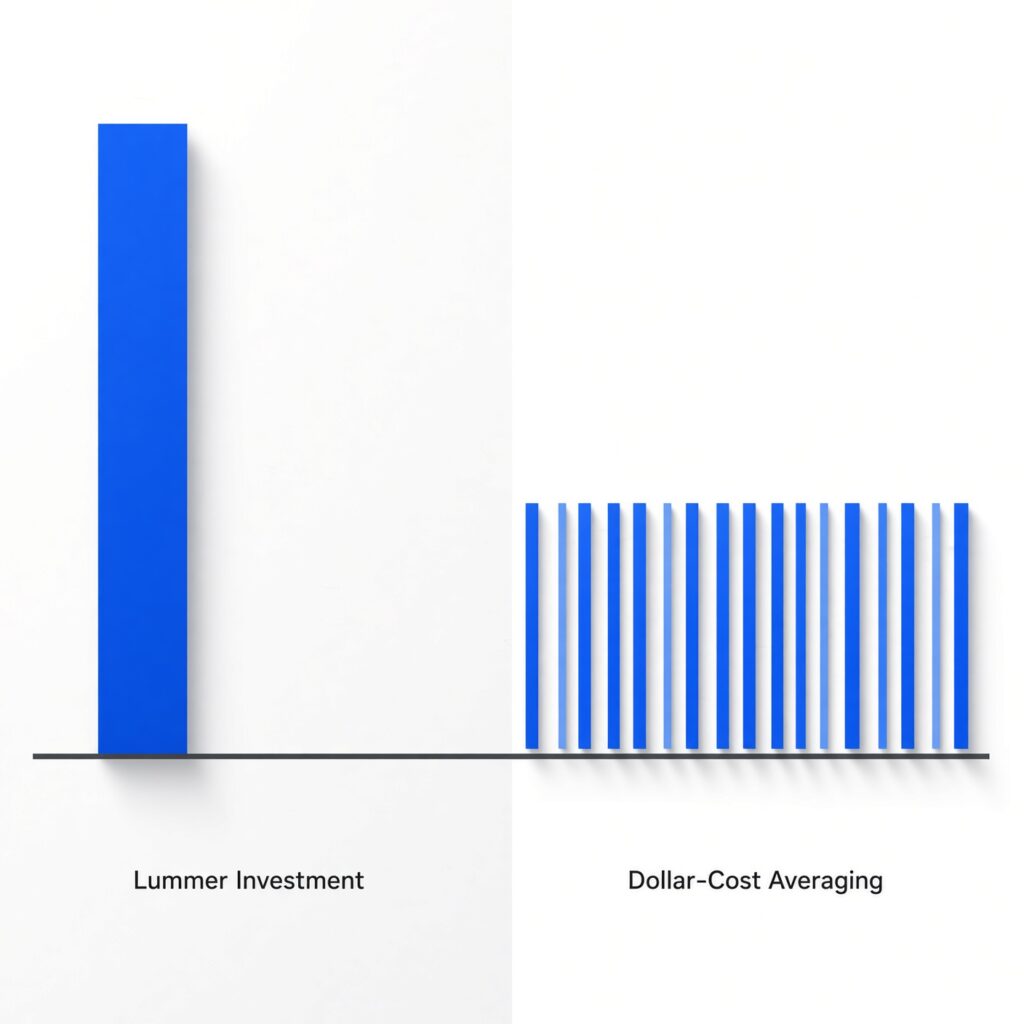
Lump-Sum Investing (LSI) involves deploying all available investment capital into selected assets at a single point in time. Whether the funds originate from an inheritance, an annual bonus, a business sale, or accumulated savings, the entire sum is placed into the market immediately.
Dollar-Cost Averaging (DCA) involves dividing a total sum of capital into smaller, equal increments and investing those portions at regular intervals—such as weekly, monthly, or quarterly—over a predetermined timeframe, regardless of asset prices or market conditions.
Historical Performance Analysis: Lump-Sum vs. DCA
Historical market data provides strong empirical evidence regarding the average returns of both strategies across broad equity indices, such as the S&P 500 and global stock markets.
Because major financial markets trend upward over long periods, Lump-Sum Investing historically outperforms Dollar-Cost Averaging approximately 66% to 75% of the time over multi-year horizons. Deploying capital immediately maximizes time in the market, allowing the full portfolio to benefit from asset appreciation, dividends, and compound growth from day one.
Dollar-Cost Averaging keeps a portion of capital in cash or short-term cash equivalents while waiting for future investment intervals. In a rising market, this cash drag reduces overall portfolio returns compared to a fully invested portfolio.
Risk Exposure and Volatility Management
While Lump-Sum Investing offers statistical advantages in historical return studies, it also exposes the investor to immediate sequence risk.
Sequence risk, or timing risk, refers to the possibility of deploying capital right before a market downturn or correction. If an investor commits a lump sum immediately prior to a major drawdown, the entire capital base experiences an immediate reduction in value. Recovering from significant losses requires patience and emotional discipline.
Dollar-Cost Averaging naturally mitigates sequence risk. By spreading purchases over time, an investor buys fewer shares when prices are high and more shares when prices decline during a market pullback. This systematic buying process lowers the average cost per share over the deployment period during choppy or declining markets.
Psychological Factors and Behavioral Finance
Investing outcomes are heavily influenced by investor behavior and emotional discipline. Theoretical mathematical superiority matters little if an investor panics during short-term volatility.
For many individuals, the psychological stress of potential immediate loss makes Lump-Sum Investing difficult to execute comfortably. The regret associated with investing a large sum right before a market drop can lead to emotionally driven decision-making, such as panic selling at the bottom.
Dollar-Cost Averaging serves as a behavioral hedge against regret. It provides a structured framework that removes emotional decision-making from the process. Even if the market declines after the initial allocation, the investor views price drops as an opportunity to purchase additional assets at lower valuations, reducing anxiety and maintaining consistency.
Cost Considerations and Operational Drag
When executing an allocation strategy, administrative and transaction expenses must be evaluated to ensure portfolio efficiency.
Executing a single lump-sum transaction minimizes trading commissions, fixed transaction fees, and administrative handling across brokers. Conversely, executing multiple scheduled trades over extended periods under a DCA model may accumulate higher transaction fees or bid-ask spread costs if the broker charges fixed commissions per trade.
However, modern brokerage platforms offering commission-free trading on major ETFs and stocks have significantly reduced the operational drag associated with high-frequency periodic investing, making Dollar-Cost Averaging more accessible and cost-effective than ever before.
Strategic Framework for Decision Making
Choosing between Lump-Sum Investing and Dollar-Cost Averaging depends on individual financial circumstances, market conditions, and personal preferences. The following decision framework can help determine the appropriate approach:
Lump-Sum Investing is typically preferred when:
- The investor has a long time horizon and high risk tolerance.
- The primary objective is maximizing expected total return.
- The investor is comfortable experiencing short-term paper losses without selling assets.
- Market historical trends favor immediate capital deployment.
Dollar-Cost Averaging is typically preferred when:
- The investor experiences significant anxiety regarding market downturns.
- Market valuations appear historically stretched or macro uncertainty is elevated.
- Capital is received incrementally over time, such as regular salary contributions.
- The primary goal is risk mitigation and smooth capital entry over a 6-to-12-month period.
Hybrid Strategies for Capital Deployment
Investors do not always need to choose exclusively between pure Lump-Sum Investing and extended Dollar-Cost Averaging. Hybrid approaches can offer a practical middle ground.
One common hybrid model involves investing a substantial portion (such as 50%) of the available capital immediately, while allocating the remaining 50% across equal monthly increments over 3 to 6 months. This approach captures market upside with the initial tranche while retaining flexibility and downside protection for the remainder of the funds.
Another variation involves opportunistic acceleration: executing a standard DCA strategy, but accelerating the deployment schedule whenever the market experiences a pull-back of 5% or 10% below recent highs.
Aligning Strategy with Financial Goals
Both Lump-Sum Investing and Dollar-Cost Averaging represent valid, structured approaches to building long-term wealth. Historically and statistically, Lump-Sum Investing generates higher average returns due to long-term market growth and continuous time in the market. However, Dollar-Cost Averaging provides vital risk mitigation, reduced volatility, and psychological security for investors sensitive to short-term downside.
Ultimately, the optimal strategy is the one that an investor can stick to consistently through all market conditions. A disciplined execution of either method will yield significantly better long-term results than remaining uninvested in cash due to market timing indecision.