
What Is Portfolio Beta and How Is It Used in Investing?

When you first start building an investment portfolio, the sheer volume of financial terminology can feel overwhelming. Words like liquidity, P/E ratio, diversification, and volatility get tossed around constantly in financial news. Among these, Portfolio Beta is one of the most critical metrics you can learn to understand.
Whether you are saving for retirement, building a dividend income stream, or trying to navigate a volatile stock market, knowing your portfolio’s beta can help you sleep better at night. But what exactly is portfolio beta, how is it calculated, and how can everyday investors use it to build a smarter, more resilient portfolio?
Let’s dive deep into everything you need to know about portfolio beta, explained in plain English.
What Exactly Is Beta in Investing? (The Baseline Definition)
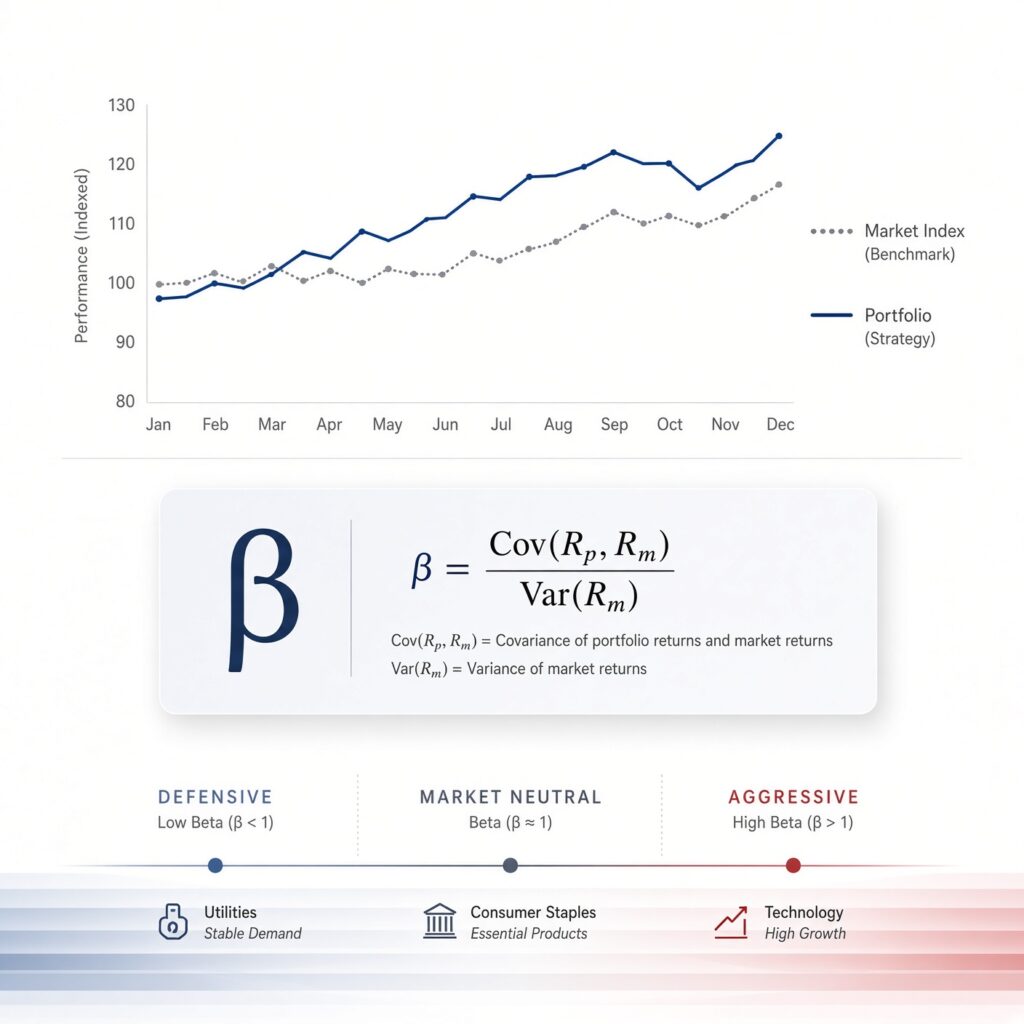
To understand portfolio beta, we first need to understand Beta on its own.
In finance, beta is a statistical measure of a stock’s or investment’s volatility in relation to the overall market. Think of the overall stock market—usually represented by a major benchmark index like the S&P 500—as the absolute standard.
By definition, the overall market always has a Beta of 1.0.
- A Beta of 1.0: The asset moves in tandem with the market. If the S&P 500 goes up by 2%, this asset tends to go up by 2%. If the market drops by 2%, it drops by 2%.
- A Beta Greater Than 1.0 (e.g., 1.5): The asset is more volatile than the market. If the market rises by 10%, a stock with a beta of 1.5 is expected to rise by 15%. Conversely, if the market drops by 10%, it is expected to fall by 15%. These are typically growth stocks, tech companies, or cyclical businesses.
- A Beta Less Than 1.0 (e.g., 0.5): The asset is less volatile than the market. If the market drops by 10%, this asset might only drop by 5%. These are typically defensive stocks, such as utilities, consumer staples, or healthcare giants, which hold steady during market turbulence.
- A Beta of 0.0: The asset has no correlation to the market whatsoever. Cash or certain Treasury bills often behave this way over short horizons.
- A Negative Beta (e.g., -0.5): The asset moves in the opposite direction of the market. When the market goes down, this asset goes up. Certain gold mining stocks or inverse ETFs exhibit this behavior.
Individual Stock Beta vs. Portfolio Beta: Understanding the Difference
Many beginner investors make the mistake of looking at the beta of a single stock and assuming it applies to their entire portfolio. However, your portfolio beta is a collective measurement.
A portfolio is rarely made up of just one company. Instead, it is a basket of different stocks, bonds, funds, and assets. Each individual asset within that basket has its own beta.
- If you own 10 different stocks, some might have a high beta of 1.8, while others have a low beta of 0.4.
- Portfolio beta calculates the weighted average of all those individual betas combined.
This means your portfolio acts as a single ecosystem. Even if you own a few high-risk, high-beta tech stocks that keep you on the edge of your seat, balancing them out with stable, low-beta dividend stocks can bring your overall portfolio beta down to a comfortable, moderate level.
Step-by-Step Guide: How to Calculate Portfolio Beta
You don’t need a degree in advanced mathematics or a Wall Street financial model to calculate your portfolio’s beta. The formula is straightforward: it is the weighted average of the betas of all the individual securities in your portfolio.
The Calculation Formula
To find your portfolio beta:
- Determine the weight (percentage of total value) of each asset in your portfolio.
- Find the beta of each asset.
- Multiply each asset’s weight by its beta.
- Add all those numbers together.
A Practical Example
Imagine you have a simple portfolio worth $10,000 divided into three different holdings:
| Asset | Total Value | Portfolio Weight | Individual Beta | Weight × Beta |
|---|---|---|---|---|
| Stock A (Tech) | $2,000 | 20% (0.20) | 1.5 | $0.20 \times 1.5 = 0.30$ |
| Stock B (S&P 500 Index Fund) | $5,000 | 50% (0.50) | 1.0 | $0.50 \times 1.0 = 0.50$ |
| Stock C (Utility Company) | $3,000 | 30% (0.30) | 0.6 | $0.30 \times 0.6 = 0.18$ |
| Total | $10,000 | 100% | Portfolio Beta = 0.98 |
In this example, the portfolio beta is 0.98. This tells you that your portfolio is slightly less volatile than the broader market. If the S&P 500 drops by 10%, your portfolio is theoretically expected to drop by about 9.8%.
Interpreting Portfolio Beta Values: What Is a “Good” Beta?

There is no universal “good” or “bad” portfolio beta. Instead, the right beta depends entirely on your personal financial goals, age, investment timeline, and risk tolerance.
1. High Portfolio Beta (1.2 to 2.0+)
- Who it’s for: Younger investors with a long time horizon (e.g., decades until retirement) who want aggressive growth and can comfortably stomach watching their account balance swing wildly up and down from month to month.
- The Trade-off: Higher potential rewards during bull markets, but devastating drawdowns during bear markets.
2. Market-Neutral Portfolio Beta (Around 1.0)
- Who it’s for: Investors looking to match the general market performance (e.g., those who buy broad-market index funds and want average market returns with average market risk).
- The Trade-off: You will experience the full force of market highs and lows without any shock absorption.
3. Low Portfolio Beta (0.3 to 0.8)
- Who it’s for: Retirees, conservative investors, or anyone prioritizing capital preservation and steady cash flow over rapid growth.
- The Trade-off: You will likely lag behind the market during massive bull runs, but your portfolio will hold its value much better during economic recessions and market crashes.
How Investors Use Portfolio Beta for Risk Management
Portfolio beta is not just a theoretical number to look at; it is an active risk management tool. Smart investors use beta to adjust their strategies across different economic cycles.
Navigating Bull and Bear Markets
- Preparing for a Bull Market (Optimistic Economy): When the economy is booming and stock prices are climbing, investors often look to increase their portfolio beta. By rotating capital into growth sectors—such as technology, consumer discretionary, and emerging markets—they push their portfolio beta above 1.0 to capture outsized gains.
- Preparing for a Bear Market (Economic Uncertainty): When economic clouds gather, interest rates rise, or a recession looms, smart investors look to decrease their portfolio beta. They shift money into defensive sectors like healthcare, utilities, and consumer staples (e.g., companies that sell groceries and toothpaste regardless of the economy), lowering their portfolio beta to weather the storm.
Aligning With Personal Risk Tolerance
Many investors accidentally take on way more risk than they realize. By calculating your portfolio beta, you can perform a “risk check.” If you discover your portfolio has a beta of 1.4, but you panic every time the market dips 5%, your portfolio beta is too high for your psychological comfort level. You can use beta as a compass to dial back your risk exposure.
The Hidden Limitations of Beta: What It Doesn’t Tell You
While beta is exceptionally useful, it is not a crystal ball. Relying on beta blindly without understanding its limitations can lead to costly mistakes. Here are the most important caveats to keep in mind:
- Beta Looks Backward: Beta is calculated using historical price data (usually over the past 3 to 5 years). A company’s past relationship with the market does not guarantee its future behavior. Market conditions change, management changes, and business models evolve.
- It Only Measures Systematic Risk: Beta measures how a stock moves relative to the market, but it ignores company-specific events. A company could have a low beta, but if the CEO commits fraud or the factory burns down, the stock price will plummet regardless of what the broader market is doing. This is known as unsystematic risk, which is solved by diversification rather than beta alone.
- Market Benchmarks Matter: Beta is always relative to a specific index (usually the S&P 500). If you are investing internationally or focusing entirely on small-cap tech stocks, comparing your portfolio to the S&P 500 might give you skewed or misleading beta readings.
Practical Strategies to Adjust Your Portfolio Beta

If you calculate your portfolio beta and realize it doesn’t match your goals, how do you fix it? You don’t need to sell everything and start over. You can adjust your portfolio beta strategically using a few straightforward methods:
1. To Lower Your Portfolio Beta
If your portfolio is too volatile and you want to calm it down:
- Add Defensive Sectors: Invest more capital into established utility providers, healthcare firms, pharmaceutical giants, and consumer staple companies.
- Incorporate Fixed Income: Allocate a portion of your portfolio to bonds, Treasury notes, or high-yield savings vehicles, which generally have a beta close to zero or negative correlation to equities.
- Allocate to Dividend Aristocrats: Companies with decades of consistent dividend growth tend to have stable, lower-beta stock profiles.
2. To Raise Your Portfolio Beta
If your portfolio is too conservative and you want to boost your growth potential:
- Add Growth and Technology Stocks: Introduce innovative sectors like artificial intelligence, renewable energy, or software-as-a-service (SaaS) companies.
- Look Into Small-Cap Stocks: Small-cap companies generally exhibit higher betas than large-cap blue chips, offering higher upside potential during economic expansions.
- Reduce Cash Holdings: Idle cash dilutes returns and lowers overall portfolio responsiveness; putting cash to work in equities naturally raises your beta.
Mastering portfolio beta is one of the most empowering steps you can take on your investing journey. It transforms investing from an emotional guessing game into a calculated science. By understanding how sensitive your assets are to broader market movements, you can tailor your portfolio to match your exact risk appetite, protect your wealth during downturns, and position yourself for sustainable, long-term financial growth.
Take a look at your holdings today, calculate your weighted average beta, and ensure your portfolio is working for you—not the other way around.