Robinhood: How Its Business Model Works

The financial services landscape experienced a massive paradigm shift when retail brokerages began dismantling standard transaction fees.At the forefront of this transformation is Robinhood, a fintech pioneer that fundamentally altered how everyday participants interact with equities, options, and digital currencies.By removing traditional barriers to entry and introducing a sleek, mobile-first interface, the platform captured the attention of tens of millions of users.
However, offering commission-free trading immediately prompts a fundamental question from market observers: how does a platform of this scale generate billions in revenue while charging its core user base nothing for basic trades?The answer lies in a diversified, highly optimized infrastructure that monetizes order routing, uninvested capital, premium subscriptions, and ancillary financial services. Analyzing this framework reveals a sophisticated corporate blueprint designed to maximize profitability across varying macroeconomic environments.
The Genesis of Commission-Free Trading and Market Accessibility

To understand the core mechanics of modern retail brokerages, one must first look at the traditional financial advisory space. Historically, executing a stock purchase or sale required paying fixed broker commissions that often ranged from five to thirty dollars per transaction. These costs heavily penalized frequent participants and discouraged smaller allocations.
Robinhood entered the market with a disruptive value proposition: absolute democratization of financial systems through zero-commission transactions. By leveraging modern cloud infrastructure and automated clearing processes instead of maintaining legacy branch networks and high-touch human advisory teams, the company drastically lowered its structural operating expenses. This efficiency enabled a business model where basic retail participation could scale infinitely without incurring linear cost increases. Consequently, millions of new participants gained immediate access to equity markets, setting off an industry-wide race to the bottom regarding commission fees across legacy Wall Street institutions.
Payment for Order Flow: Unpacking Transaction-Based Income
While users do not pay explicit commissions on standard equity, options, or cryptocurrency transactions, trading activity remains a primary engine for top-line revenue.This mechanism operates primarily through a practice known as Payment for Order Flow, commonly abbreviated as PFOF.
When a retail customer submits an order to buy or sell a security within the application, the platform routes that execution request to specialized third-party market makers and high-frequency trading firms rather than directing it immediately to a traditional public exchange floor.These market makers handle massive volumes of buy and sell orders simultaneously, allowing them to capture tiny price discrepancies known as the bid-ask spread.
In exchange for receiving this steady stream of retail volume, market makers pay the brokerage a fraction of a cent per share or contract.While these individual payments appear microscopic, aggregate transaction volumes scaling into the billions of shares and contracts generate substantial revenue.Transaction-based streams encompass distinct categories:
- Options Trading:Advanced derivative contracts frequently yield higher per-contract routing payments compared to standard equities, serving as a major financial pillar during periods of elevated market volatility.
- Equities Execution:High-volume stock trading contributes steady routing revenue based on daily market participation rates.
- Digital Assets:Cryptocurrency trading activities involve distinct liquidity structures, providing alternative transaction-based revenue depending on retail sentiment.
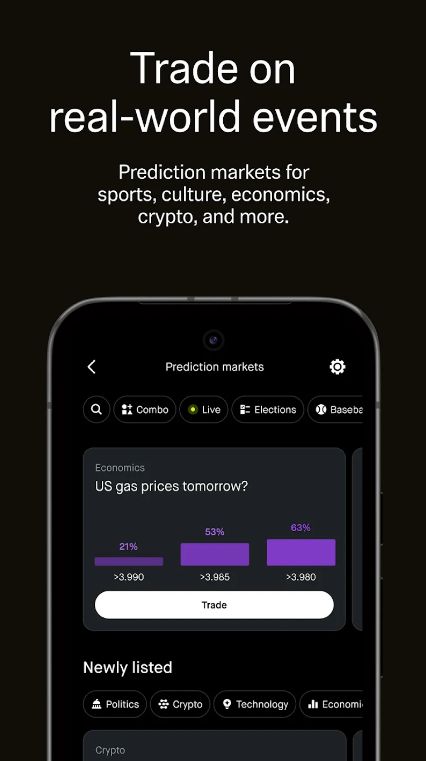
- Event Contracts and Derivatives:Emerging specialized prediction markets and index options offer additional high-velocity trading streams.
Net Interest Revenue: Monetizing Idle Cash and Margin Lending
Beyond routing trades, modern fintech brokerages function much like traditional financial institutions by generating robust earnings from interest-earning assets.When interest rates fluctuate across the broader economy, this segment acts as a powerful financial stabilizer, often offsetting periods of lower trading volume.
The net interest revenue stream relies on several core mechanisms:
- Cash Sweep Programs:Uninvested capital sitting inside customer accounts is often swept into network partner banks, where it earns interest. The platform collects a spread between the interest paid to the end user and the higher yield earned from the banking partners.
- Margin Lending:Users who borrow capital against their existing portfolio equity to leverage their positions pay borrowing interest.As the total margin book expands, this financing activity generates substantial recurring income.
- Securities Lending:The platform participates in programs where fully paid shares held by customers are temporarily lent out to institutional market participants for short-selling or settlement purposes, generating fee income.
These interest-driven avenues ensure that even when retail participants choose to hold idle cash during uncertain macroeconomic cycles, the underlying business model continues to capture predictable monetary yield.
Robinhood Gold: The Power of the Freemium Subscription Model
To diversify away from pure transaction and interest sensitivity, the platform successfully implemented a tiered freemium architecture anchored by its premium subscription tier.This membership model transforms casual participants into committed, high-value ecosystem participants by bundling exclusive financial utilities into a predictable monthly or annual recurring fee.
Subscribers receive an array of enhanced financial privileges that incentivize deeper platform integration:
- Elevated Yields on Cash:Members gain access to significantly higher annual percentage yields (APY) on their uninvested cash balances compared to standard tiers.
- Professional Research and Data:Access to institutional-grade equity research reports, level-two market data depth, and automated portfolio analysis tools.
- Integrated Credit and Spending Solutions:Premium physical cards offering attractive cash-back rewards on everyday purchases, driving transaction interchange fees.
- Favorable Margin Rates: Lower interest costs for utilizing borrowing power within approved margin accounts.
This subscription strategy creates a dual advantage: it secures a predictable, recurring stream of software-as-a-service style revenue while simultaneously driving higher customer engagement, larger asset deposits, and increased cross-platform utility.
Expanding Financial Ecosystems: Banking, Retirement, and Wealth Management
Long-term viability in the digital brokerage sector requires continuous product diversification.Rather than remaining a simple application for executing short-term stock orders, modern financial platforms aggressively expand horizontally into broader wealth management services.
The introduction of retirement accounts featuring direct contribution matches incentivizes long-term asset retention rather than transient trading.By capturing retirement savings, custodial arrangements, and automated recurring deposits, platforms lock in multi-decade customer relationships.Furthermore, international expansion efforts introduce localized investment products tailored to foreign regulatory frameworks, unlocking entirely new geographic demographics.
Ancillary revenue lines also contribute meaningfully to the bottom line:
- Account Transfer Fees:Standard processing charges applied when external assets move between brokerages.
- Shareholder Communication Services:Digital proxy voting and corporate governance engagement tools that monetize corporate issuer interactions.
- Media and Publishing:Educational digital newsletters and financial media properties that capture targeted marketing and advertising revenues.
Regulatory Landscape and Structural Risk Factors
Operating a high-velocity, technology-driven brokerage involves navigating a complex matrix of regulatory compliance and systemic market vulnerabilities. Because a significant portion of operating income relies on payment for order flow and margin financing, any shifts in federal policy or regulatory oversight regarding trade routing practices can directly impact financial performance.
Additionally, retail trading activity remains inherently cyclical.Periods of macroeconomic expansion, high retail enthusiasm, and speculative momentum naturally trigger spikes in trading volume, driving record transaction-based earnings. Conversely, prolonged market contractions or low volatility environments can compress trading frequency. To mitigate these cyclical swings, successful brokerage operators continue shifting focus toward sticky, recurring revenue streams such as subscription fees, cash management interest, and long-term retirement assets.
The Future Evolution of Retail Brokerage Economics
The ongoing success of zero-commission trading models proves that traditional Wall Street fee structures are largely obsolete for retail investors.By cleverly re-engineering how financial plumbing generates capital—substituting direct consumer commissions with intelligent order routing, net interest margins, software subscriptions, and comprehensive banking services—modern fintech platforms have carved out a highly profitable niche.
As these ecosystems mature, the dividing line between traditional banking, personal financial management, and active stock trading continues to blur.Platforms that successfully aggregate everyday banking, retirement planning, credit products, and sophisticated trading tools under a single digital roof are best positioned to capture the unfolding generational wealth transfer.Ultimately, the genius of this business model lies in aligning free consumer access with behind-the-scenes institutional efficiency, creating a scalable engine that profits quietly at every turn of the modern financial wheel.