Merrill Edge Guided Investing: How Does It Work?

Navigating the world of investments can often feel overwhelming, especially for beginners who want to grow their wealth without spending hours analyzing stock charts, tracking market trends, or constantly rebalancing portfolios. For individuals seeking a middle ground between completely hands-on trading and traditional, high-cost financial planning, hybrid digital wealth management services have emerged as a popular solution. Among these, Merrill Edge Guided Investing—backed by the financial strength of Bank of America and the market expertise of Merrill Lynch—stands out as a prominent choice for everyday investors.
Understanding how this platform works, what it costs, and whether it fits your financial objectives is essential before committing your hard-earned money. This guide breaks down the core mechanics of Merrill Edge Guided Investing, exploring its features, investment strategies, account options, and overall user experience in clear, straightforward terms.
What Is Merrill Edge Guided Investing?

At its core, Merrill Edge Guided Investing is an online automated investment advisory program—frequently referred to in the financial industry as a robo-advisor with a human touch. Unlike self-directed brokerage accounts where you select and trade every individual stock, bond, or exchange-traded fund (ETF) yourself, Guided Investing takes a hands-off approach on your behalf.
When you enroll in the program, professional investment managers and sophisticated algorithms construct and maintain a diversified portfolio tailored specifically to your unique financial situation. It combines digital convenience with the institutional research capabilities of the Bank of America Global Wealth and Investment Management Chief Investment Office. This means your portfolio isn’t just driven by generic automated software; it benefits from professional oversight rooted in extensive institutional market analysis.
How Merrill Edge Guided Investing Works Step-by-Step
Getting started with the platform involves a structured onboarding process designed to understand your financial personality, risk comfort, and long-term objectives. The journey typically follows a clear path:
1. Defining Your Financial Goals
Every investor starts with a specific destination in mind—whether that is saving for retirement, building a down payment for a home, funding higher education, or preparing for a major life event. The platform prompts you to select and label your primary goals, giving the system a clear target to track over time.
2. Completing the Risk Profile Questionnaire
To determine how your money should be invested, you must answer a series of questions regarding your timeline, income stability, current savings, and emotional comfort with market volatility. Your responses dictate your risk score, which ranges from conservative to aggressive, ensuring that your asset allocation aligns with your ability to weather market swings.
3. Portfolio Selection and Customization
Based on your goals and risk profile, the system recommends a targeted portfolio strategy. Investors generally choose between standard market-tracking strategies or sustainable/impact investing approaches, which focus on environmental, social, and governance (ESG) criteria.
4. Funding and Ongoing Management
Once you fund your account and meet the initial minimum deposit requirements, the platform purchases the underlying assets—primarily consisting of vetted ETFs and mutual funds selected by Merrill experts. From that point forward, the system monitors your portfolio daily, executing automatic rebalancing when market movements push your asset allocation away from its original target.
Core Features and Portfolio Management Strategies
The true value of a guided investment platform lies in the tools and automation working behind the scenes to keep your financial plan on track. Several core features define the experience:
- Automatic Rebalancing: Over time, certain asset classes will grow faster than others, skewing your original risk profile. The platform automatically adjusts your holdings periodically to maintain your target asset allocation without requiring manual intervention.
- Institutional Research Integration: Portfolios are built using asset allocations vetted by the Chief Investment Office, granting everyday investors access to insights typically reserved for high-net-worth clients.
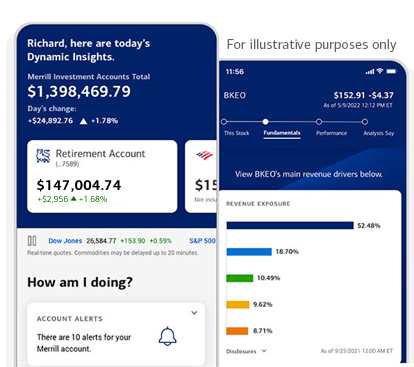
- Goal Tracking Dashboard: Investors gain constant access to a personalized online dashboard through desktop and mobile apps. Here, you can monitor performance metrics, check progress toward milestones, and adjust your contributions.
- Seamless Bank Integration: For clients who already utilize Bank of America checking or savings accounts, linking profiles provides a unified view of your entire financial life, allowing instant cash transfers between banking and investing dashboards.
Account Options Available Under Guided Investing
Flexibility in account types is crucial for long-term financial planning, as different goals require different tax structures. Merrill Edge Guided Investing supports a wide variety of accounts, including:
- Standard Taxable Brokerage Accounts: Ideal for general savings goals that do not have specific retirement or educational tax restrictions.
- Traditional IRAs: Perfect for individuals looking to make tax-deductible contributions now and pay ordinary income tax upon withdrawal in retirement.
- Roth IRAs:Funded with after-tax dollars, allowing your investments to grow and be withdrawn completely tax-free in retirement, provided certain conditions are met.
- Rollover IRAs: Designed for consolidating old employer-sponsored 401(k) plans from past jobs into a single, manageable individual retirement account.
Understanding the Costs: Fees and Account Minimums
Before opening any investment account, evaluating the fee structure is vital to ensure long-term returns are not eroded by excessive costs.
- Management Fees:Merrill Edge Guided Investing charges an annual program fee of 0.45% of your total managed assets.This fee is calculated and assessed monthly based on the previous month’s ending balance.For comparison, if you maintain a steady balance of $10,000, your annual advisory fee would come out to roughly $45, billed in monthly increments.
- Advisor-Assisted Tier:If you prefer direct, one-on-one access to a human financial advisor to discuss your strategy, you can opt for Merrill Guided Investing with Advisor, which raises the annual management fee to 0.85%.
- Account Minimums: To enroll in the standard automated digital program, investors typically need a minimum opening balance of $5,000 (though certain IRA configurations or promotional structures may vary). For the advisor-assisted tier, a higher balance requirement—typically starting at $20,000—is enforced.
- Underlying Fund Expenses:Keep in mind that while the management fee covers portfolio construction and rebalancing, the individual ETFs and mutual funds held within your portfolio carry their own internal expense ratios charged by the fund providers.
Comparing Guided Investing to Self-Directed Trading
A common dilemma for newcomers is choosing between Merrill Edge Self-Directed accounts and the Guided Investing alternative.
With a Self-Directed account, you pay $0 commission on online stock, ETF, and options trades, but you bear 100% of the responsibility for picking investments, monitoring market trends, and executing rebalancing trades.There is no minimum balance requirement, making it attractive for active traders or DIY investors who enjoy managing their own portfolios.
Conversely, Guided Investing removes the day-to-day decision-making burden. You pay the 0.45% management fee in exchange for professional oversight, automated maintenance, and peace of mind. It is built specifically for passive investors who want professional guidance without paying the steep fees associated with traditional full-service wealth management firms, which often require hundreds of thousands of dollars in minimum assets.
Potential Drawbacks and Limitations
While the platform offers a streamlined experience, it is important to weigh potential limitations against your personal investment style:
- Lack of Tax-Loss Harvesting:Unlike some competing digital robo-advisors that automatically harvest investment losses to offset capital gains taxes, Merrill Edge Guided Investing does not feature automated tax-loss harvesting. This is an important consideration for taxable brokerage accounts where tax efficiency is a priority.
- Investment Vehicle Restrictions: Your portfolio is restricted to pre-selected mutual funds and ETFs chosen by the firm. You cannot use Guided Investing to buy individual stocks, cryptocurrency, or niche sector funds directly within that managed portfolio.
- Advisory Fees: While 0.45% is competitive compared to traditional human advisors, it is slightly higher than some standalone digital-first robo-advisors that charge closer to 0.25%. You are essentially paying extra for the backing of Bank of America and Merrill’s physical branch network and research infrastructure.
Is Merrill Edge Guided Investing Right for You?
Deciding whether to use this service depends heavily on your financial literacy, available capital, and desire for active involvement.
The platform is an excellent fit if you already bank with Bank of America, appreciate having a unified financial dashboard, have at least $5,000 to invest, and prefer a completely hands-off investment strategy backed by established institutional research. It eliminates the emotional stress of market timing and ensures your portfolio stays disciplined through shifting economic cycles.
On the other hand, if you prefer selecting your own individual equities, want to avoid management fees entirely, or require advanced tax-optimization strategies like tax-loss harvesting, a self-directed brokerage account or an alternative robo-advisor might better suit your financial goals. By carefully assessing your comfort with risk, your long-term objectives, and your budget for advisory fees, you can choose the path that sets your wealth up for sustainable growth.