15-Year vs. 30-Year Mortgage: How Much Interest Can You Save?

Buying a home is arguably the single largest financial transaction you will ever make in your lifetime. For most home buyers, unless you are paying completely in cash, financing the purchase requires a mortgage. When you sit down with a lender or browse real estate listings, you will quickly encounter one of the most critical fork-in-the-road decisions in personal finance: choosing between a 15-year fixed-rate mortgage and a 30-year fixed-rate mortgage.
At first glance, the choice might seem simple. A 30-year mortgage gives you lower monthly payments, while a 15-year mortgage gets you out of debt faster. However, beneath the surface lies a dramatic difference in total loan costs, interest accumulation, long-term wealth building, and monthly budgeting flexibility.
If you have ever wondered just how much money you can save by choosing a shorter loan term—and whether those savings are worth the tighter monthly budget—this comprehensive guide will break down everything you need to know in plain, easy-to-understand English.
Understanding the Fundamentals: What is a 30-Year Mortgage?
The 30-year fixed-rate mortgage is the undisputed heavyweight champion of the American housing market. For decades, it has been the go-to financial vehicle for millions of families striving to achieve homeownership.
How the 30-Year Term Works
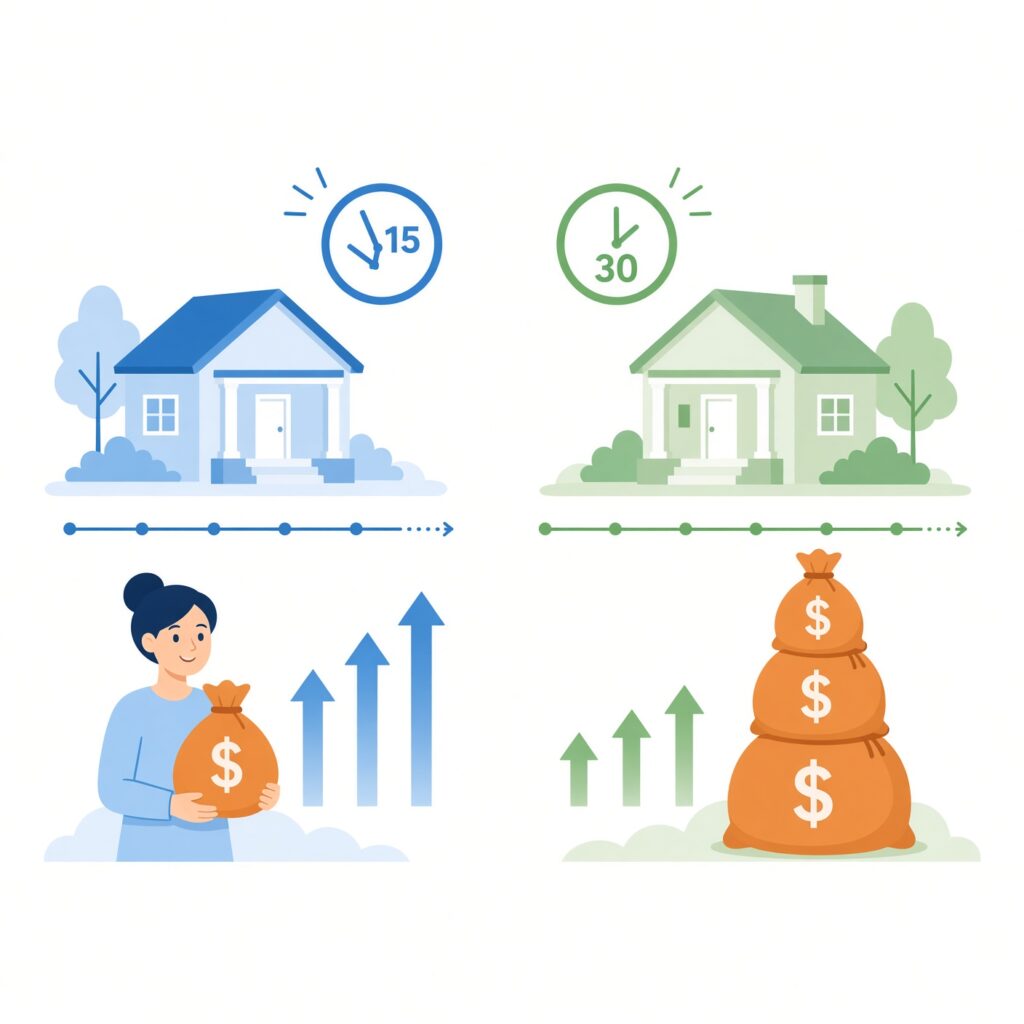
When you take out a 30-year mortgage, you agree to pay back the principal (the original amount you borrowed) plus interest over a span of 360 monthly payments. Because the repayment timeline is stretched out over three decades, your monthly principal and interest payments are significantly lower than they would be on a shorter loan for the exact same home price.
The Allure of Lower Monthly Payments
The primary advantage of a 30-year mortgage is affordability on a monthly basis. Lower payments mean:
- It is easier to qualify for the loan based on your monthly income.
- You leave more room in your monthly budget for other expenses, such as groceries, utilities, vehicle maintenance, childcare, and savings.
- You have a financial cushion in case of unexpected life events, job changes, or medical emergencies.
However, this monthly comfort comes at a steep price: time and compound interest. Because you are borrowing the bank’s money for twice as long, interest has twice as many years to accumulate. By the time your 30th year rolls around, you may have paid far more in total interest than the actual purchase price of the home itself.
Breaking Down the 15-Year Mortgage: Speed and Savings
On the other side of the ring is the 15-year fixed-rate mortgage. While it commands a smaller market share than its 30-year counterpart, it is widely celebrated by financial experts and debt-free advocates for its incredible wealth-building power.
How the 15-Year Term Works
A 15-year mortgage requires you to repay the exact same principal amount, but compressed into just 180 monthly payments instead of 360. Because the lender gets their money back in half the time, they charge you significantly less in total interest.
The Fast Track to Absolute Ownership
Opting for a 15-year term means you will own your home free and clear in half the time. Imagine making your final mortgage payment while you are still in your peak earning years, completely eliminating your largest monthly expense long before retirement. This creates immense peace of mind and frees up massive cash flow for your golden years.
The catch? Your monthly mortgage payment will be substantially higher because you are cramming the entire principal repayment into a much shorter window. This requires a higher household income or a more conservative home purchase price to qualify.
The Core Comparison: Monthly Payments vs. Total Interest Cost
To truly understand the difference between these two loan products, let us look at a realistic financial scenario using round numbers.
Imagine you are purchasing a home for $400,000, and you put down 20% ($80,000), leaving you with a loan amount of $320,000.
- Scenario A: 30-Year Fixed Mortgage at a 6.5% Interest Rate
- Monthly Principal & Interest Payment: Roughly $2,022
- Total Payments over 30 Years: Roughly $728,000
- Total Interest Paid: Roughly $408,000
- Scenario B: 15-Year Fixed Mortgage at a 5.8% Interest Rate(Note: 15-year rates are historically lower than 30-year rates)
- Monthly Principal & Interest Payment: Roughly $2,661
- Total Payments over 15 Years: Roughly $479,000
- Total Interest Paid: Roughly $159,000
The Bottom Line on Savings
In this scenario, your monthly payment on the 15-year mortgage is $639 higher than the 30-year option. However, look at the total interest: you save a staggering $249,000 in interest payments over the life of the loan. That is a quarter of a million dollars staying in your pocket rather than going straight to the bank.
How Much Interest Can You Actually Save?
The exact amount of interest you save depends on three core variables: the loan amount, the interest rate spread between the two terms, and how long you stay in the home.
The Power of Lower Interest Rates
Lenders reward the lower risk of a 15-year mortgage by offering lower interest rates—typically between 0.5% and 0.75% lower than 30-year rates. This double bonus (shorter timeline + lower rate) creates an exponential reduction in interest charges.
Breaking Down the Amortization Effect
Amortization is the schedule by which your loan payment is split between principal and interest.
- In a 30-year loan, for the first 10 to 12 years, the vast majority of your monthly payment goes toward paying interest rather than reducing the actual loan balance.
- In a 15-year loan, you begin eating away at the principal balance immediately and aggressively. Because the balance shrinks twice as fast, the amount of interest charged each month drops dramatically faster.
The Hidden Trade-Offs: Cash Flow and Budget Flexibility
While saving hundreds of thousands of dollars in interest sounds like a no-brainer, personal finance is personal. Math is only part of the equation; human behavior and cash flow management matter just as much.
The Risk of a Higher Fixed Obligation
When you commit to a 15-year mortgage, that higher monthly payment is mandatory. If you experience a job loss, a pay cut, or unexpected medical bills, that hefty payment doesn’t shrink. A 30-year mortgage offers a built-in safety net: your mandatory monthly baseline is lower, giving you more breathing room if lean times hit.
The “Hybrid” Strategy: Taking a 30-Year and Paying Like a 15-Year
Many financially savvy homeowners utilize a clever workaround: they take out a 30-year mortgage, but they make payments equivalent to a 15-year mortgage.
By paying the higher 15-year amount every single month while locked into a 30-year contract, you get the best of both worlds:
- You aggressively pay down the principal and save massive amounts of interest.
- If you hit a financial rough patch, you can legally drop your payment back down to the lower 30-year minimum without facing foreclosure or delinquency.
The downside to this hybrid strategy? 30-year interest rates are typically slightly higher than 15-year rates, so you won’t save quite as much as you would with a true 15-year loan, but the flexibility trade-off is often worth it for peace of mind.
Property Taxes, Insurance, and Escrow: What Stays the Same?
When evaluating monthly mortgage payments, remember that your principal and interest are only part of the equation. Your total monthly housing payment—often referred to as PITI—includes four components:
- Principal: The money that goes toward paying off the actual loan balance.
- Interest: The fee charged by the lender for borrowing the money.
- Property Taxes: Levies charged by your local government based on your home’s assessed value.
- Homeowners Insurance: Coverage to protect your property against damage, theft, and liability.
Escrow Account Realities
Regardless of whether you choose a 15-year or 30-year mortgage, your property taxes and homeowners insurance will cost the exact same amount. These costs are determined by your local municipality and insurance provider, not your loan term.
Because property taxes and insurance remain identical across both loan types, the percentage difference in your total monthly payment will actually be slightly smaller than the difference in principal and interest alone. For example, if your PITI payment on a 30-year is $2,500 and on a 15-year is $3,139, the jump feels slightly less intimidating when viewed in the context of your total monthly housing budget.
Refinancing Options: Can You Switch Later?
Life is unpredictable, and financial situations change. A common question among home buyers is whether they can lock in a 30-year mortgage now and refinance into a 15-year mortgage later down the road when their income increases.
Refinancing Realities and Costs
Yes, refinancing is entirely possible. If your career advances, your salary grows, or interest rates drop significantly in the future, you can refinance your remaining balance into a 15-year term.
However, refinancing is not free. Closing costs typically run between 2% and 6% of the loan amount. If you refinance too early or too often, those closing fees can eat up a significant portion of the interest savings you were hoping to achieve. Therefore, choosing the right loan term from the very beginning is always the most cost-effective strategy.
Opportunity Cost: Investing the Difference vs. Paying Off Debt Early
One of the most robust debates in modern personal finance centers around the concept of opportunity cost. If you choose a 30-year mortgage and invest the monthly savings into the stock market instead, will you come out ahead compared to paying off a 15-year mortgage early?
The Arguments for the Stock Market
Proponents of this theory argue that over long historical periods, a diversified portfolio of stock index funds (such as the S&P 500) yields an average annual return of roughly 7% to 10% (adjusted for inflation).
- If your 30-year mortgage rate is relatively low (e.g., 5%), and you can invest the difference in funds yielding 8%, basic math suggests you are better off keeping the lower mortgage payment and investing the surplus cash.
- Your money remains liquid and accessible in brokerage accounts, whereas home equity is “locked in concrete” and difficult to access without selling or borrowing against the home.
The Arguments for Guaranteed Debt Elimination
On the flip side, paying off a mortgage early provides a guaranteed, risk-free return equal to your mortgage interest rate.
- Earning a 5.8% or 6.5% guaranteed return by eliminating debt is extremely attractive, especially during periods of stock market volatility.
- There is an unmatched psychological freedom and emotional well-being that comes with owning your home outright. A completely paid-off house dramatically lowers your cost of living, providing ultimate security against job loss or economic downturns.
Ultimately, this choice depends on your personal risk tolerance and investment discipline. If you know you will spend the monthly difference on lifestyle inflation rather than investing it, the forced savings of a 15-year mortgage is vastly superior.
Is a 15-Year Mortgage Right for You?
Choosing a 15-year mortgage is a bold, disciplined financial move. It is generally the right fit if you meet the following criteria:
- High Budgetary Headroom: Your monthly income is stable and robust enough to comfortably absorb the higher payment without straining your everyday living expenses.
- Retirement Horizon is Approaching: You are in your 40s or 50s and want to ensure your home is completely paid off by the time you retire, dramatically slashing your retirement income requirements.
- Low Debt-to-Income (DTI) Ratio: Your total debt payments (including the higher mortgage) consume a very small percentage of your gross monthly income.
- Low Tolerance for Debt: You place a high personal value on the psychological peace of mind that comes with being completely debt-free as fast as possible.
Is a 30-Year Mortgage the Safer Bet?

The 30-year mortgage remains the standard for a reason. It is typically the right choice if you fall into these categories:
- First-Time Homebuyer: You are buying your first home and want to keep your monthly obligations conservative while you learn the ropes of homeownership and property maintenance.
- Maximizing Cash Flow Flexibility: You prefer to maintain higher monthly liquidity to fund retirement accounts (like 401ks and IRAs), build an emergency fund, or invest in other assets.
- Variable or Commission-Based Income: Your income fluctuates from month to month, making a lower baseline monthly payment a safer insurance policy against lean months.
- Intentional Hybrid Investors: You plan to take the 30-year loan for safety, but commit to making higher voluntary principal payments whenever your cash flow allows.
How to Calculate Your Debt-to-Income (DTI) Ratio for Both Options
Before falling in love with either a 15-year or 30-year mortgage, lenders will evaluate your financial fitness using your Debt-to-Income (DTI) ratio. Your DTI compares your monthly debt payments to your gross monthly income.
Calculating Your Front-End and Back-End DTI
- Front-End DTI (Housing Ratio): This measures what percentage of your income goes toward housing costs alone (Principal, Interest, Taxes, Insurance). Lenders generally prefer a front-end ratio under 28%.
- Back-End DTI (Total Debt Ratio): This measures all your monthly debt obligations combined—housing plus car loans, student loans, credit card minimums, and personal loans. Lenders typically look for a back-end ratio under 36% to 43%, though some loan products allow higher limits.
Because a 15-year mortgage carries a significantly higher monthly housing payment, it will push your front-end and back-end DTI ratios much higher than a 30-year loan would. Run your numbers carefully, or consult with a trusted mortgage broker, to see which loan tier your income safely qualifies for without stretching your finances to the breaking point.
Making the Right Choice for Your Financial Future
Deciding between a 15-year and a 30-year mortgage is not a one-size-fits-all proposition. It requires an honest assessment of your current income, your long-term career trajectory, your retirement goals, and your personal comfort level with monthly financial commitments.
If building rapid home equity and saving hundreds of thousands of dollars in lifetime interest payments is your ultimate priority—and your monthly budget can comfortably handle the heavier lifting—the 15-year mortgage is an exceptional financial tool.
If you value maximum monthly cash flow flexibility, want a larger financial safety net for unexpected life events, or prefer the freedom to invest your surplus cash elsewhere, the 30-year mortgage remains a tried-and-true foundation for homeownership.
Take your time, run the exact numbers for your price point, evaluate your household budget realistically, and choose the path that empowers you to build lasting wealth while sleeping peacefully at night.