The Complete Guide to Bitcoin Mining: How It Works, Network Security, and the Future of Proof of Work

Cryptocurrency has transformed the global financial landscape, and at the absolute center of this digital revolution is Bitcoin. Often described as digital gold, Bitcoin relies on a decentralized network that operates without any central bank, government, or intermediary. But how does new Bitcoin actually come into existence? How are transactions verified, and what keeps the entire network secure against fraud?
The answer lies in Bitcoin mining.
Whether you are a crypto enthusiast, an aspiring blockchain developer, or simply curious about how digital assets function under the hood, understanding mining is essential. This comprehensive guide explores everything you need to know about Bitcoin mining—from the fundamental cryptographic mechanics to hardware requirements, energy consumption, and the long-term outlook of the industry.
What Is Bitcoin Mining? Understanding the Fundamentals
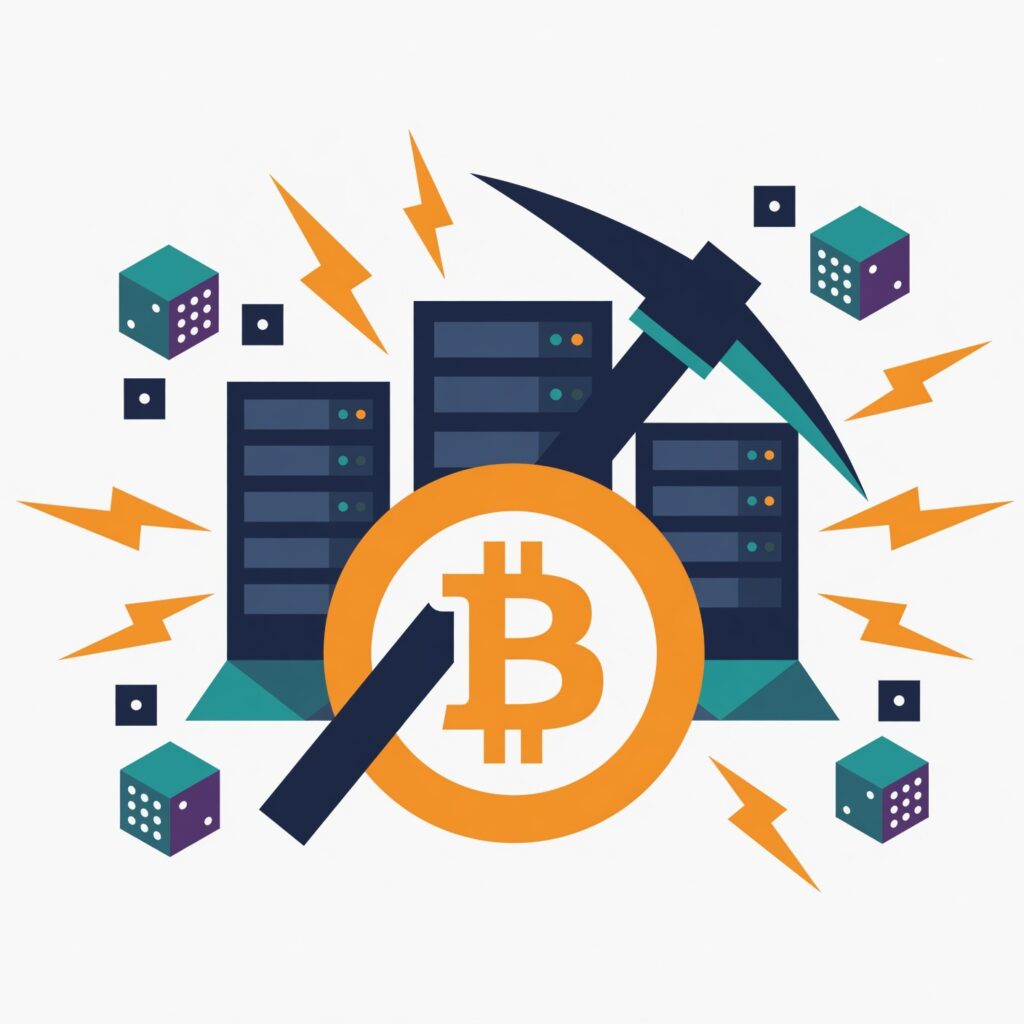
At its core, Bitcoin mining serves two critical functions within the decentralized network:
- Issuing new Bitcoin into circulation.
- Validating and securing transactions on the Bitcoin blockchain.
Unlike traditional fiat currencies—such as the US Dollar, Euro, or Yen—which are printed by central banks based on monetary policy and economic conditions, Bitcoin has a strictly capped supply of 21 million coins. New coins cannot be arbitrarily printed. Instead, they are minted programmatically as a reward to participants who contribute computational power to the network.
Think of Bitcoin miners as a combination of global auditors and security guards. Every time someone sends Bitcoin from one wallet to another, that transaction enters a pool of unconfirmed transactions known as the mempool. Miners take these transactions, group them together into a data structure called a block, and work to add that block permanently to the public ledger—the blockchain.
How Bitcoin Mining Works Step-by-Step
To fully appreciate the complexity of the mining process, it helps to break down the technical journey a transaction takes from the moment it is initiated until it becomes permanently etched into the blockchain.
1. Transaction Broadcast and the Mempool
When a user initiates a transaction, it is broadcast to the peer-to-peer Bitcoin network. Nodes (computers running the Bitcoin software) verify the validity of the transaction (ensuring the sender has sufficient funds and hasn’t attempted a double-spend). Once verified, the transaction sits in the mempool waiting to be picked up by a miner.
2. Block Assembly
Miners select transactions from the mempool to package into a candidate block. Miners generally prioritize transactions with higher fee rates, as they keep these fees as an additional incentive alongside the block reward. Alongside these transactions, the miner includes a special transaction known as the coinbase transaction, which directs the newly minted Bitcoin reward to their own wallet address.
3. The Proof-of-Work Puzzle (Cryptographic Hashing)
Once the block header is assembled, the miner faces a computational challenge. They must run the block header data through a cryptographic hashing algorithm known as SHA-256 (Secure Hash Algorithm 256-bit).
A cryptographic hash function takes an input of any size and produces a fixed-size 256-bit string (represented as a 64-character hexadecimal number). The critical property of SHA-256 is that it is a one-way function: you cannot look at the output and determine the input, and even a tiny change in the input completely alters the output (known as the avalanche effect).
To successfully mine a block, a miner’s hardware must repeatedly hash the block header data combined with a variable number called a nonce (number used once). The goal is to find a resulting hash that falls below a specific target set by the network. Because the output of SHA-256 is entirely unpredictable, miners cannot calculate the correct nonce mathematically; they must guess trillions of times per second through brute force until they find a valid hash.
4. Network Propagation and Consensus
The moment a miner discovers a valid hash that meets the network’s difficulty requirement, they instantly broadcast the newly minted block to the rest of the Bitcoin network. Other nodes and miners quickly verify that:
- The transactions within the block are valid and have not been double-spent.
- The cryptographic proof-of-work is mathematically correct and meets the current difficulty target.
Once verified by the majority of the network, the block is accepted and chained chronologically to the previous blocks. At this point, the transactions inside the block are considered confirmed.
The Role of Hardware: From CPUs to ASICs
The hardware used to mine Bitcoin has evolved dramatically since the network’s inception in 2009. What started as a hobby that could be performed on a standard home laptop has transformed into an industrialized sector dominated by massive data centers and specialized silicon chips.
Central Processing Units (CPUs)
In the early days of Bitcoin, creator Satoshi Nakamoto and early adopters used standard desktop CPUs to mine. Because very few people were participating, the computational difficulty was exceptionally low, allowing anyone with a standard computer to earn significant amounts of Bitcoin.
Graphics Processing Units (GPUs)
As the network grew, miners realized that GPUs (graphics cards originally designed for high-end video gaming and rendering) were far more efficient at parallel processing. GPUs could perform cryptographic hashing operations significantly faster than CPUs, shifting the mining landscape away from personal computers.
Field-Programmable Gate Arrays (FPGAs)
For a brief period, miners utilized FPGAs—integrated circuits that could be configured and customized by the customer after manufacturing. While more energy-efficient than GPUs, they were quickly outpaced by technology built for a singular purpose.
Application-Specific Integrated Circuits (ASICs)
Today, Bitcoin mining is entirely dominated by ASIC (Application-Specific Integrated Circuit) machines. These are microprocessors specifically engineered to perform only one task: executing the SHA-256 hashing algorithm as fast and efficiently as possible. Modern ASIC rigs are marvels of modern engineering, operating at immense speeds while consuming thousands of watts of electricity. Running an ASIC requires specialized electrical infrastructure, robust cooling systems, and industrial-grade noise management, making home mining largely obsolete for profitability.
Understanding Mining Difficulty and the Target

One of the most brilliant aspects of Bitcoin’s protocol is its automatic difficulty adjustment mechanism.
If thousands of new miners join the network with powerful ASIC hardware, blocks would theoretically be solved much faster than the target time of one minute every 10 minutes. Conversely, if miners leave the network, blocks would slow down.
To prevent this, the Bitcoin protocol automatically adjusts the mining difficulty every 2,016 blocks (roughly every two weeks).
- If blocks were found faster than the 10-minute average during the previous period, the network increases the difficulty by lowering the target threshold (making it mathematically harder to find a valid hash).
- If blocks took longer than 10 minutes, the difficulty decreases, making it easier for remaining miners to find blocks.
This self-regulating mechanism ensures that Bitcoin issuance remains stable and predictable regardless of how much total computational power (known as the hashrate) enters or leaves the network.
Bitcoin Halving: Economic Mechanics and Scarcity
The economic engine driving Bitcoin mining is designed to mirror and improve upon precious metals like gold. This is governed by a built-in event known as the Bitcoin halving, which occurs every 210,000 blocks (approximately every four years).
When Bitcoin was launched in 2009, the reward for successfully mining a single block was 50 BTC. The halving event cuts this block reward precisely in half:
- 2009: 50 BTC per block
- 2012: 25 BTC per block
- 2016: 12.5 BTC per block
- 2020: 6.25 BTC per block
- 2024: 3.125 BTC per block
This scheduled reduction in supply issuance continues geometrically until all 21 million Bitcoins have been mined, which is projected to happen around the year 2140.
Why the Halving Matters
The halving directly impacts the economics of mining. As the block reward decreases, miners receive fewer newly minted coins for their computational work. Consequently, miners must rely more heavily on transaction fees paid by users to remain profitable. For the broader market, the halving reduces the daily influx of new supply entering circulation, which historically has created significant macroeconomic scarcity dynamics.
Energy Consumption and Environmental Impact
No discussion of Bitcoin mining is complete without addressing its energy footprint. Because ASIC miners perform trillions of cryptographic calculations per second, the global Bitcoin network consumes a substantial amount of electricity.
The Debate Over Energy Use
Critics argue that the proof-of-work consensus mechanism demands excessive electrical power, contributing to carbon emissions if the energy is sourced from fossil fuels like coal or natural gas.
The Evolution Toward Renewable Energy
Conversely, industry advocates and data analytics firms point out unique characteristics of Bitcoin mining that differentiate it from traditional heavy industries:
- Location Agnostic: Bitcoin mining operations can be established virtually anywhere in the world, including remote locations far from urban centers. This allows miners to tap into stranded or wasted energy sources—such as flared natural gas at oil extraction sites or excess renewable energy generated by wind, solar, and hydroelectric power plants that cannot be efficiently transmitted to the grid.
- Grid Balancing: Mining operations can act as flexible load resources for power grids. During periods of peak energy demand, miners can instantly power down their rigs to relieve pressure on the grid, helping utility providers manage load balance and support grid stability.
- Methane Mitigation: Innovative mining projects capture methane gas emitted from landfills or agricultural waste and use it to power generators for mining, actively converting a potent greenhouse gas into productive economic energy.
Mining Pools: Why Individual Solo Mining Is Rare
As the total hashrate of the global Bitcoin network scaled into astronomical numbers, the probability of an individual miner finding a block independently became akin to winning a massive lottery.
Imagine participating in a lottery where you purchase a single ticket against millions of other participants. You might wait years or decades before winning a payout. To smooth out revenue and ensure steady cash flow, miners organized into mining pools.
How Mining Pools Work
A mining pool is a cooperative platform where thousands of miners from around the world pool their computing power together.
- The pool operator coordinates the collective hash power to solve blocks collaboratively.
- When any miner in the pool successfully finds a valid block, the resulting block reward (and associated transaction fees) is distributed proportionally among all participants based on the share of computational work they contributed.
While mining pools charge a small management fee (usually ranging from 1% to 3%), they provide reliable, consistent payouts, making them the standard operating model for both mid-sized operations and large industrial mining enterprises.
Security, Decentralization, and the 51% Attack
The primary reason Bitcoin commands such high security and trust is the sheer magnitude of its decentralized proof-of-work network.
To tamper with transaction history on the blockchain—such as attempting to reverse a transaction or execute a double-spend—an attacker would need to control more than 50% of the total network hashrate (commonly referred to as a 51% attack).
Why the Bitcoin Network Is Virtually Unhackable
Achieving 51% control of Bitcoin requires billions of dollars in specialized ASIC hardware, immense physical infrastructure, and continuous access to gigawatts of cheap electricity. Furthermore:
- Even if an entity somehow acquired this vast amount of power, they could only alter very recent transactions or prevent new transactions from being confirmed; they cannot steal coins from secure private keys or rewrite the entire history of the blockchain.
- Attempting such an attack would immediately alert the global network, causing the value of Bitcoin to plummet, which would render the attacker’s astronomical hardware investment worthless overnight.
This economic game theory aligns the incentives of miners, holders, and users: everyone benefits most by playing by the rules and securing the network honestly.
Economic Viability: What Makes a Mining Operation Profitable?

For those looking at the business side of Bitcoin mining, profitability is governed by a delicate balancing act of several key variables. It is not simply a matter of plugging in a machine and collecting revenue; miners must continuously monitor operational economics.
1. Electricity Costs
The single largest operational expense for any mining facility is power. Even small variations in electricity rates (measured in kilowatt-hours, or kWh) can mean the difference between a highly profitable enterprise and a bankrupt operation. Successful miners secure long-term energy contracts in regions with cheap, abundant power.
2. Hardware Efficiency
The hash rate per watt (Joules per Terahash) dictates how efficiently an ASIC converts electricity into computational output. Older machine models quickly become obsolete as manufacturers release new generations of ASICs that deliver higher hashrates with lower power draw.
3. Bitcoin Market Price
Because mining rewards are paid out in Bitcoin, the fiat market price of BTC heavily dictates revenue. When the price of Bitcoin rises, mining operations become significantly more lucrative, incentivizing expansion. When the price drops, high-cost miners may be forced to turn off their machines until market conditions improve.
4. Network Difficulty
As explored earlier, total network difficulty determines how much computational effort is required to earn a share of the block reward. Higher difficulty paired with a stagnant or falling Bitcoin price creates margin compression for miners.
The Future of Bitcoin Mining
As the cryptocurrency ecosystem continues to mature, the Bitcoin mining sector is undergoing continuous transformation. Several emerging trends are shaping the future of how blocks are mined and verified:
- Advanced Cooling Technologies: Traditional air cooling is increasingly being replaced by immersion cooling, where ASIC rigs are submerged in specially engineered dielectric fluids. This enhances heat dissipation, allows for higher overclocking limits, and extends the operational lifespan of hardware components.
- Geographic Diversification: Following regulatory shifts and the crackdown on mining in certain regions over recent years, mining operations have decentralized across diverse global jurisdictions, seeking favorable regulatory environments, political stability, and stranded energy resources.
- Integration with Artificial Intelligence (AI): A fascinating emerging trend involves large-scale data center operators combining high-performance computing (HPC) for artificial intelligence workloads with Bitcoin mining infrastructure, optimizing energy usage and revenue streams across multiple digital sectors.
Conclusion
Bitcoin mining is far more than a technical process for creating new digital currency; it is the cryptographic backbone that anchors the world’s most secure and decentralized financial network. By replacing traditional institutional trust with transparent mathematics and game theory, proof-of-work mining ensures that Bitcoin remains censorship-resistant, immutable, and truly decentralized.
From the early days of individual laptops solving simple equations to today’s massive, energy-innovative industrial facilities, mining continues to evolve at the cutting edge of technology and economics. Whether viewed as an engineering marvel, an environmental pioneer in energy utilization, or a revolutionary monetary security system, Bitcoin mining remains the foundational engine driving the future of digital finance.