What Is a Seed Phrase and Why Is It the Most Important Key to Your Crypto Wealth?

Cryptocurrency has revolutionized how we think about money, shifting the power from centralized institutions directly into the hands of individuals. With this unprecedented financial sovereignty, however, comes a profound level of personal responsibility. Unlike traditional banking, where a forgotten password can be easily reset with a quick call to customer support or an email verification link, the decentralized world operates entirely differently. In the crypto ecosystem, you are your own bank.
At the center of this self-custody model lies a foundational concept that every crypto holder must understand: the seed phrase.
Whether you are buying your first fraction of Bitcoin, exploring decentralized finance (DeFi), or collecting rare digital art on marketplaces, your security depends entirely on how well you understand and protect your seed phrase. This comprehensive guide will explore what a seed phrase is, how it works under the hood, why it is vital for your financial security, and the absolute best practices to ensure your digital assets remain safe from theft and loss.
Understanding Cryptocurrency Wallets and Private Keys
To truly grasp what a seed phrase is, you first need to understand how crypto wallets function. A common misconception among beginners is that cryptocurrency is actually “stored” inside a digital wallet like a physical leather wallet holds cash. In reality, your coins and tokens never leave the blockchain—the decentralized, public ledger distributed across thousands of computers worldwide.
Instead, a crypto wallet stores something much more critical: cryptographic keys.
Public Keys vs. Private Keys
- Public Key: Think of this as your cryptocurrency email address or IBAN. It is safe to share with others so they can send you funds.
- Private Key: This is your digital signature and password combined. It grants absolute control over the funds associated with your public address. Anyone who knows your private key has total ownership of your crypto assets.
Originally, managing a crypto wallet meant interacting directly with long, complex strings of alphanumeric characters representing these private keys—often looking like randomized sequences of 64 hexadecimal characters. Memorizing or even safely writing down multiple private keys for different cryptocurrencies was extraordinarily difficult and prone to human error.
What Exactly Is a Seed Phrase?
To solve the complexity and vulnerability of managing raw private keys, industry innovators introduced a standardized solution defined by the Bitcoin Improvement Proposal 39 (BIP39) in 2013. This standard gave birth to the seed phrase—also commonly referred to as a recovery phrase, backup phrase, or mnemonic phrase.
A seed phrase is a sequence of 12, 18, or 24 random words chosen from a standardized dictionary of 2048 English words.
When you set up a new non-custodial wallet (such as MetaMask, Trust Wallet, Ledger, or Trezor), the software generates this unique sequence of words for you. This sequence acts as a master key. From this single list of words, your wallet’s software mathematically derives all of your private keys, public addresses, and transaction capabilities across multiple different blockchains.
A Concrete Example of a Seed Phrase
A typical 12-word seed phrase might look something like this:
apple banana cherry dolphin elephant forest guitar harbor island jungle lemon mountain
(Note: Never use this example sequence, as it is public and insecure!)
Because all your various crypto accounts—whether Bitcoin, Ethereum, Solana, or Polygon—are mathematically generated from this single root phrase, backing up your wallet becomes as simple as writing down these 12 to 24 words in the exact correct order.
How Seed Phrases Work Behind the Scenes
The brilliance of the seed phrase system lies in its deterministic nature. Specifically, modern crypto wallets use what is known as a Hierarchical Deterministic (HD) wallet architecture (based on BIP32 and BIP44 standards).
The Mathematical Hierarchy
- The Entropy: When creating a wallet, the software generates a block of random data called entropy.
- The Checksum: The software adds a checksum to verify accuracy.
- Mnemonic Conversion: This binary data is mapped directly against the standardized BIP39 word list to generate your human-readable seed phrase.
- The Master Seed: Through a cryptographic key-derivation function called PBKDF2, your seed phrase is converted into a heavy master seed.
- Child Key Derivation: From this master seed, the wallet generates an infinite tree of private and public keys for hundreds of different blockchains.
Because of this system, you do not need a separate backup every time you receive funds, generate a new receiving address, or interact with a new blockchain network. Your original seed phrase recovers the entire tree of assets.
Why Your Seed Phrase Is Critical for Financial Security
The phrase “not your keys, not your coins” is a foundational mantra in the cryptocurrency community. If you keep your crypto on a centralized exchange, the platform holds the seed phrases and private keys on your behalf. While convenient, this exposes you to counterparty risk—if the exchange gets hacked, goes bankrupt, or freezes withdrawals, your funds could be lost.
Moving your assets to a self-custody wallet gives you total control, but it places 100% of the security burden on your shoulders. Here is why protecting your seed phrase is non-negotiable:
1. Total Irreversibility
Transactions on decentralized blockchains are immutable. There is no customer service department, no password reset button, and no fraud department that can reverse a transaction or restore access to your wallet if your seed phrase is lost or compromised.
2. Protection Against Device Failure
Hardware wallets break, smartphones get dropped in water, and laptops crash. If your physical device fails or gets lost, your crypto is not gone—provided you have your seed phrase. You can purchase a brand-new device, enter your seed phrase, and instantly restore access to 100% of your funds.
3. Absolute Ownership
With a secure seed phrase backup, you possess absolute sovereignty over your wealth. No government, bank, or third party can freeze, confiscate, or censor your funds.
Common Misconceptions and Risks Involving Seed Phrases
Despite their importance, seed phrases are frequently misunderstood, leading to catastrophic losses for unsuspecting users. Let us clear up some of the most dangerous myths and pitfalls.
Myth 1: “My Seed Phrase Is Stored on the Blockchain”
Many beginners believe that because blockchain is decentralized and permanent, their seed phrase is safely stored “in the cloud” or on the network. This is completely false. The blockchain knows nothing about your seed phrase. Your seed phrase exists solely on your local device and your offline backup. If you lose your device and your physical backup, your funds are permanently unrecoverable.
Myth 2: “I Can Store My Seed Phrase in My Email or Cloud Notes”
Convenience is the ultimate enemy of security. Typing your seed phrase into digital notes, taking a screenshot, emailing it to yourself, or saving it in a password manager creates a massive digital vulnerability. If your email account, cloud storage, or device is ever compromised by malware or phishing, hackers will instantly steal your entire net worth.
The Dangers of Phishing and Social Engineering
The vast majority of cryptocurrency thefts do not happen through complex mathematical hacking of the blockchain; they happen through human manipulation.
- Fake Support Scams: Scammers posing as wallet support staff may ask you to “verify your wallet” by entering your seed phrase into a website. Legitimate wallet providers will never ask for your seed phrase.
- Malicious Apps: Downloading unauthorized or counterfeit wallet applications from app stores can instantly leak your seed phrase the moment you input it. Always download software directly from official, verified websites.
Best Practices for Storing and Protecting Your Seed Phrase
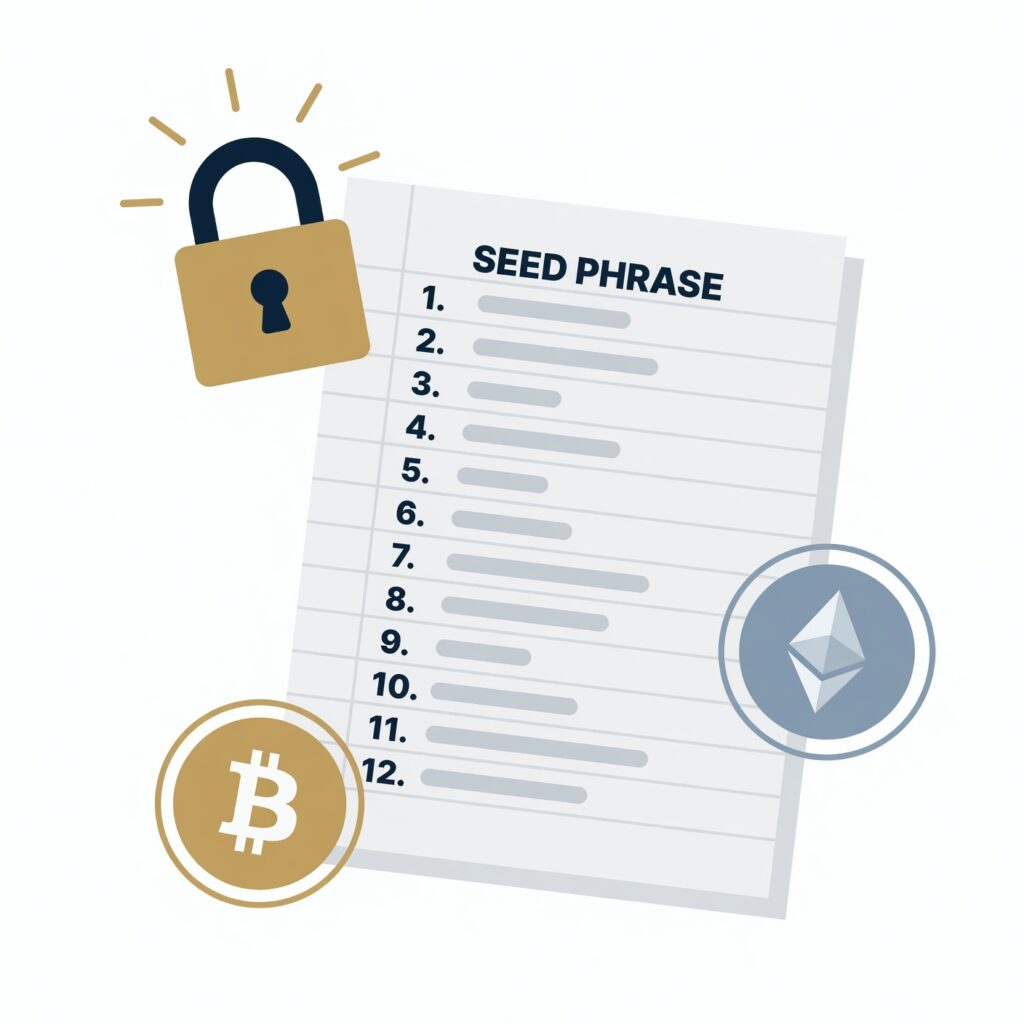
Securing your seed phrase requires a shift in mindset toward physical, offline security. Follow these golden rules to keep your digital wealth safe from prying eyes and unforeseen disasters.
1. Always Keep It Offline (Analog Security)
Your seed phrase should never touch the internet. This means:
- Never take a photo of it.
- Never type it into a computer, phone, or tablet.
- Never store it in a digital document, cloud drive, or encrypted note (unless handled via advanced, air-gapped hardware procedures meant for power users, though paper is safer for most).
2. Write It Down on Physical Mediums
The standard approach is to write your words clearly and in the correct numerical order on a piece of high-quality paper or cardstock. For superior longevity and protection against house fires, floods, or degradation, many experienced crypto holders invest in steel backup plates (such as Cryptosteel or Billfodl). These devices allow you to stamp or punch your seed words into stainless steel plates, making them virtually indestructible.
3. Make Multiple Secure Physical Copies
If your single paper backup gets destroyed in a kitchen fire or water leak, your recovery path is gone. Consider creating two physical copies of your seed phrase and storing them in separate, highly secure physical locations (such as a home safe and a trusted family member’s secure location, or a bank safety deposit box).
4. Never Share Your Seed Phrase With Anyone
Your seed phrase is equivalent to the master key to your house, combined with the PIN to your bank vault. Anyone who asks for your seed phrase—regardless of how official, helpful, or friendly they appear—is attempting to steal your assets.
5. Double-Check Word Order and Spelling
When writing down your seed phrase during wallet creation, verify every single word. BIP39 words are standardized, and writing down a misspelled word or mixing up the sequence will result in a completely different wallet or an inability to recover your funds later. Always test your backup by restoring the wallet on a secondary device before funding it with large amounts of capital.
What to Do If Your Seed Phrase Is Compromised
If you ever suspect that someone else has seen, photographed, or gained access to your seed phrase, you must act immediately to protect your assets. Time is of the essence in the decentralized world.
- Do Not Panic, But Move Fast: Spin up a secure, uncompromised device.
- Create a New Wallet: Generate a brand-new wallet with a brand-new, uncompromised seed phrase.
- Transfer Your Funds: Immediately send all of your cryptocurrency assets from your old, compromised wallet addresses to the new wallet addresses.
- Abandon the Old Wallet: Once emptied, permanently discard the old seed phrase and never use that wallet again.
Because blockchain transactions are irreversible, you must beat the potential attacker to the punch. If they access the phrase first, they will drain your funds before you can move them.
The Future of Self-Custody and Security
As the cryptocurrency ecosystem continues to mature globally, user experience and security are evolving side by side. Emerging technologies like social recovery wallets, passkeys, and account abstraction are working to make self-custody more intuitive for everyday users without sacrificing the core tenets of decentralization.
However, regardless of how user-friendly applications become, the fundamental concept of the seed phrase remains the bedrock of cryptographic self-ownership.
By taking the time to properly understand what a seed phrase is, respecting its power, and implementing rigorous offline backup habits, you ensure that you remain the sole master of your financial destiny. In the decentralized economy, knowledge and discipline are your ultimate shields—protect your seed phrase, and you protect your future.