Understand how the price of Bitcoin is determined

The digital asset landscape has grown exponentially over the past decade, transforming from a niche cryptographic experiment into a trillion-dollar global financial ecosystem. At the center of this revolution stands Bitcoin, the pioneering cryptocurrency that commands a massive share of the digital asset market’s total valuation. With Bitcoin currently trading near the $63,000 threshold—backed by a robust circulating supply, institutional adoption through exchange-traded funds, and shifting macroeconomic conditions—investors and financial enthusiasts constantly ask a fundamental question: how is the price of Bitcoin actually determined?
Unlike traditional fiat currencies such as the US Dollar, Euro, or Japanese Yen, Bitcoin has no central bank, monetary authority, or government backing it. There is no physical printing press, nor is there an interest rate committee convening behind closed doors to decide its valuation. Instead, Bitcoin’s price is entirely a product of open-market dynamics, decentralized network architecture, and economic principles.
The Fundamentals of Decentralized Valuation and Market Equilibrium

To understand how a digital token gains monetary value, one must first dismantle traditional notions of asset pricing. In conventional finance, a company’s stock price is often evaluated using metrics like price-to-earnings ratios, future cash flows, and balance sheets. Commodities like gold or oil are evaluated based on extraction costs, industrial utility, and physical reserves. Bitcoin, however, operates differently. Its valuation is established entirely at the intersection of supply and demand across a fragmented, global network of cryptocurrency exchanges.
Market equilibrium for Bitcoin is reached dynamically every single second of the day. When buyers outnumber sellers and aggressive capital flows into the ecosystem, the price climbs as willing purchasers bid higher amounts to acquire available coins. Conversely, when macro headwinds, regulatory uncertainty, or profit-taking triggers an influx of sellers, order books tilt downward, forcing prices to contract until a level of buyer support is found. Because the market operates 24 hours a day, 365 days a year without traditional market openings and closings, this price discovery process is continuous, highly volatile, and entirely decentralized.
Supply Dynamics: The Fixed Cap and Programmatic Scarcity
The most critical pillar governing the long-term valuation framework of Bitcoin is its rigid and unyielding supply schedule. Programmed by its anonymous creator, Satoshi Nakamoto, Bitcoin has a strict maximum supply cap of 21 million coins. This hard cap cannot be altered, modified, or bypassed by any individual, corporation, or government, making it fundamentally different from fiat currencies, which can be expanded infinitely through quantitative easing and monetary inflation.
The Halving Cycle and Issuance Rate Reduction
Every four years, or more precisely every 210,000 blocks mined, Bitcoin undergoes an event known as the “halving.” During this event, the reward distributed to miners for securing the network and validating transactions is cut in half.
- Initial Issuance: When the network launched, miners received 50 bitcoins per newly minted block.
- Subsequent Reductions: Through successive halvings, this reward has dropped dramatically over time.
- Economic Impact: This programmatic reduction constrains the incoming supply of newly minted coins entering the open market. Assuming constant or growing demand, reducing the rate of new supply creation exerts upward pressure on the asset’s valuation over long market cycles.
Stock-to-Flow Ratio and Deflationary Design
Financial analysts frequently evaluate Bitcoin through the lens of the stock-to-flow ratio—a metric that measures the current stock of an asset divided by its annual production rate. Because Bitcoin’s production rate halves predictably while its existing stock remains largely intact, its stock-to-flow ratio rises steadily, placing it on par with or even exceeding traditional scarce assets like gold. This built-in scarcity forms the bedrock of its bullish long-term valuation thesis.
Demand Drivers: Adoption, Institutional Capital, and Utility
While supply establishes the boundaries of scarcity, demand dictates the actual price level at any given point in time. Over the years, the composition of Bitcoin buyers has evolved from early-adopter technologists and retail hobbyists to massive institutional conglomerates, corporate treasuries, and everyday investors accessing regulated investment vehicles.
Institutional Inflows and Regulated Investment Products
The introduction of spot exchange-traded funds (ETFs) in major financial markets has fundamentally transformed how capital flows into Bitcoin. These regulated financial instruments allow institutional giants, pension funds, wealth managers, and retail brokerage clients to gain direct exposure to Bitcoin without needing to manage private cryptographic keys or navigate specialized crypto platforms.
When institutional sentiment turns positive, net inflows into these investment products absorb large tranches of circulating supply, reducing immediate liquidity on exchanges and driving prices higher. Conversely, periodic outflows from these funds can create temporary selling pressure and short-term price corrections across the broader market.
Corporate Treasuries and Macroeconomic Hedging
In an era characterized by persistent inflationary pressures, fluctuating global fiat purchasing power, and geopolitical instability, corporations and high-net-worth individuals increasingly view Bitcoin as a sovereign-grade digital store of value. Organizations holding Bitcoin on their balance sheets treat it as a long-term treasury reserve asset designed to protect corporate capital against currency devaluation. This institutionalization of demand builds deep structural support floors during market pullbacks.
The Role of Bitcoin Miners and Production Costs
A common misconception among market participants is that the cost of mining a bitcoin dictates its market price. In traditional manufacturing, the price of a good is heavily influenced by the cost of the raw materials and labor required to produce it. In the world of cryptocurrency, the causality is actually inverted: market price dictates mining profitability, not the other way around.
Hash Rate, Mining Difficulty, and Network Security
Miners expend massive amounts of electrical power and utilize specialized hardware known as Application-Specific Integrated Circuits (ASICs) to solve complex cryptographic puzzles and append new blocks to the blockchain.
- Automatic Difficulty Adjustments: The Bitcoin protocol features a self-regulating mechanism that adjusts mining difficulty roughly every two weeks. If the price of Bitcoin drops significantly, rendering older mining rigs unprofitable, operators turn off their machines, causing the network hash rate to drop. The protocol then automatically lowers the mining difficulty, making it easier for remaining miners to find blocks.
- Operational Overhead: Miners must frequently liquidate a portion of their newly mined Bitcoin rewards to cover fixed operational expenditures such as electricity, facility maintenance, and hardware upgrades. During periods of sharp market downturns, miner capitulation can introduce sudden waves of selling pressure into the order books.
Market Liquidity, Order Books, and Exchange Dynamics
The actual transaction where a buyer and seller agree on a specific price takes place on digital asset exchanges and over-the-counter (OTC) trading desks. Understanding how these platforms function is essential to grasping short-term price volatility.
Order Book Depth and Slippage
An exchange’s order book is a real-time electronic list of buy and sell orders organized by price levels.
- Bid-Ask Spread: The gap between the highest price a buyer is willing to pay (bid) and the lowest price a seller is willing to accept (ask) defines market liquidity.
- Market Depth: Markets with deep liquidity can absorb large purchase or sale orders without causing drastic price swings. Conversely, thinner order books are susceptible to high volatility, where a single large transaction can trigger cascading liquidations in derivatives markets, rapidly pushing prices up or down.
Arbitrage and Global Price Uniformity
Because Bitcoin trades simultaneously on hundreds of independent exchanges across different geographies and fiat currencies, minor price discrepancies frequently appear between platforms. Professional traders and automated arbitrage bots exploit these microscopic price gaps by buying low on one exchange and instantly selling high on another. This continuous arbitrage activity ensures that global Bitcoin prices remain tightly synchronized across the entire worldwide marketplace.
Macroeconomic Influences and Global Financial Markets
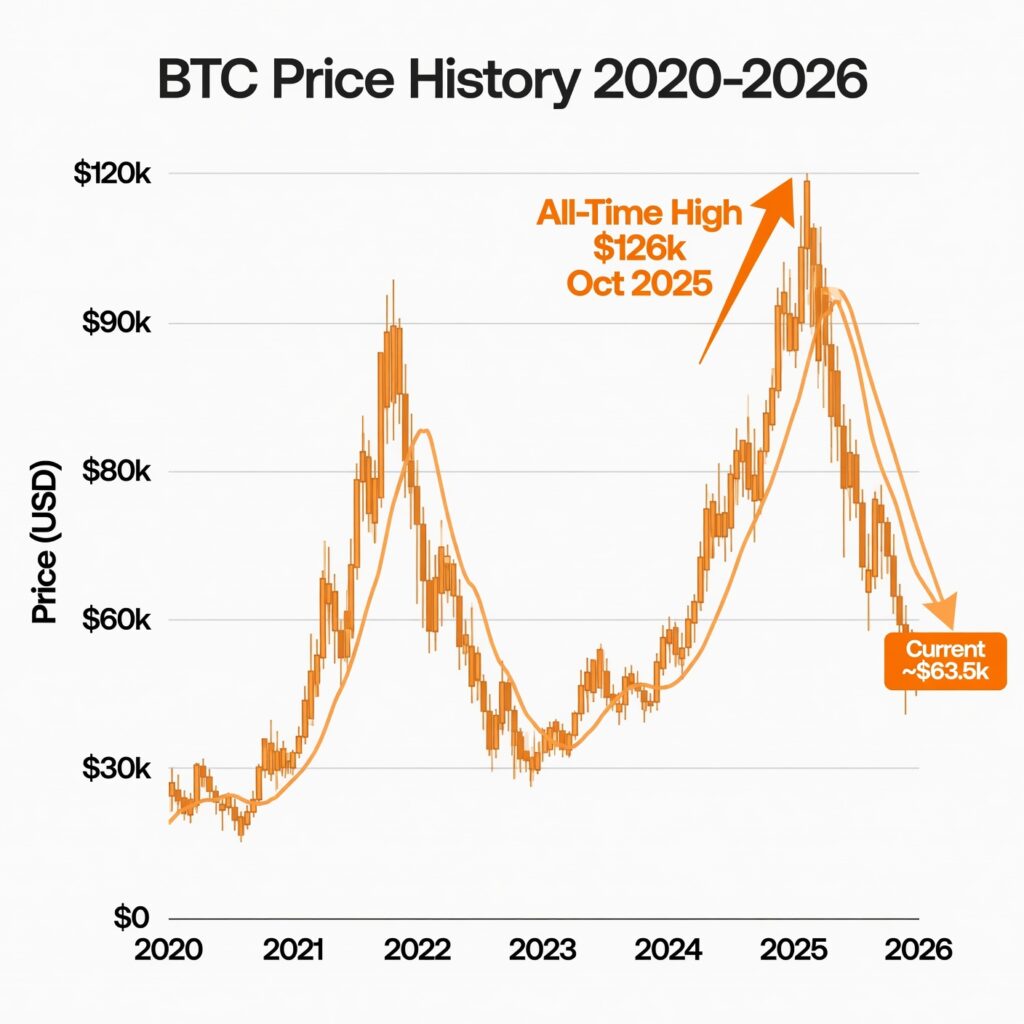
No financial asset exists in a vacuum. Although Bitcoin was originally conceived as an independent, decentralized alternative to the traditional fiat banking system, its price action is increasingly correlated with broader global macroeconomic trends and traditional financial market indicators.
Central Bank Monetary Policy and Interest Rates
Global liquidity conditions heavily dictate investor risk appetite. When central banks—such as the US Federal Reserve—maintain low interest rates and inject liquidity into the financial system, borrowing costs drop, and capital frequently flows into alternative, high-growth asset classes, including cryptocurrencies.
Conversely, when central banks adopt hawkish monetary policies, raising interest rates to combat inflation, yields on risk-free government bonds and fixed-income assets rise. This dynamic often draws capital away from risk-on assets like digital currencies, placing downward pressure on valuations as market participants seek safe-haven yields.
Inflation Expectations and Currency Devaluation
In economies experiencing high inflation or severe depreciation of local fiat currencies, citizens frequently turn to Bitcoin as a decentralized monetary exit strategy to preserve their personal wealth. In these regions, local demand surges independently of Western institutional trends, demonstrating how localized economic pressures can influence broader global sentiment.
Sentiment Analysis, Market Psychology, and Media Cycles
Beyond cold mathematical code and macroeconomic data, human psychology plays an extraordinarily powerful role in determining short-term and medium-term price movements. Financial markets are driven by two primary emotional extremes: fear and greed.
The Crypto Fear and Greed Index
Market analysts monitor behavioral indicators like the Crypto Fear and Greed Index to gauge prevailing market sentiment.
- Extreme Fear: Occurs during sharp market corrections or regulatory scares. Prices are often undervalued during these phases as panic selling creates generational buying opportunities for long-term investors.
- Extreme Greed: Characterizes parabolic bull runs fueled by mainstream media attention, retail FOMO (fear of missing out), and excessive speculative leverage in derivatives markets. These periods frequently precede sharp corrections as the market becomes overextended.
The Impact of Narrative Cycles
The cryptocurrency sector moves through distinct narrative-driven cycles. Themes such as decentralized finance (DeFi), non-fungible tokens (NFTs), layer-2 scaling solutions, and institutional ETF approvals capture public imagination, channeling fresh capital into the ecosystem and propelling prices upward.
The Multifaceted Nature of Bitcoin Pricing

Ultimately, the price of Bitcoin is not determined by any single entity, formula, or event. It is a complex, emergent property resulting from the constant interaction between immutable programmatic scarcity, global macroeconomic forces, institutional adoption trends, miner economics, exchange liquidity, and human psychology.
As the digital asset class matures and integrates deeper into the global financial fabric, understanding these underlying pricing mechanics becomes essential for anyone navigating the modern investment landscape. Whether viewing Bitcoin through the lens of a long-term store of value or an innovative technological network, its valuation remains a pure reflection of global supply meeting global demand in real-time.