Bitcoin vs Ethereum: Which Crypto Asset Should You Choose for Your Portfolio?

When entering the world of digital assets, every investor eventually faces the ultimate dilemma: Bitcoin or Ethereum? As the two undisputed giants of the blockchain ecosystem, they command the vast majority of market capitalization, yet they serve entirely different purposes. Choosing between them is not merely about picking a winning coin; it is about aligning your financial strategy with your long-term risk tolerance, investment horizon, and economic philosophy.
Navigating the modern cryptocurrency market requires a deep understanding of what drives these digital assets. With Bitcoin trading near $63,000 and Ethereum holding ground around the $1,865 mark, market participants are closely evaluating their utility, macroeconomic standing, and growth potential. This comprehensive comparison will dissect the core differences, underlying technologies, and strategic applications of both assets to help you determine which one deserves a prominent spot in your portfolio.
Understanding the Core Philosophy of Bitcoin

Bitcoin, launched in 2009 by the anonymous creator Satoshi Nakamoto, was engineered to solve a fundamental problem: the reliance on centralized financial intermediaries. Conceived in the wake of the 2008 global financial crisis, Bitcoin introduced a peer-to-peer electronic cash system built on a decentralized ledger known as the blockchain. Its primary design is to act as a secure, immutable, and censorship-resistant store of value.
The scarcity of Bitcoin is hardcoded into its protocol. With a maximum supply cap of 21 million coins ever to be minted, it introduces absolute mathematical scarcity into a world accustomed to fiat currency expansion. Every four years, through an event called the halving, the rate of new Bitcoin creation is cut in half, steadily reducing supply inflation. This predictable monetary policy has earned Bitcoin the moniker of “digital gold,” attracting institutional allocators, corporate treasuries, and everyday savers looking for a hedge against macroeconomic instability and currency devaluation.
The Evolution and Utility of Ethereum
Launched in 2015 by Vitalik Buterin and a team of co-founders, Ethereum expanded the boundaries of blockchain technology far beyond simple monetary transactions. While Bitcoin was designed to be sound money, Ethereum was built to be a global, decentralized computing platform. It introduced the concept of smart contracts—self-executing code stored on the blockchain that automatically triggers agreements when predefined conditions are met.
Ethereum serves as the foundational layer for an entire ecosystem of decentralized applications (dApps). It powers decentralized finance (DeFi) protocols, non-fungible token (NFT) marketplaces, decentralized autonomous organizations (DAOs), and layer-2 scaling solutions. The native utility token of the network, Ether, is required to pay for transaction fees, commonly known as gas, to execute operations on the network. Consequently, Ethereum derives its value not just from its narrative as a monetary asset, but from its immense utility as the underlying operating system for Web3.
Comparative Analysis: Tokenomics and Supply Dynamics
To evaluate Bitcoin and Ethereum effectively, one must examine their economic designs, issuance models, and supply mechanics. While both utilize a proof-of-stake consensus mechanism (with Bitcoin relying on energy-intensive proof-of-work mining secured by specialized hardware and Ethereum transitioning completely to a proof-of-stake model via validator staking), their tokenomics differ significantly.
Bitcoin’s issuance is entirely deterministic and front-loaded, winding down slowly over more than a century until the final satoshi is mined. There is no mechanism to burn Bitcoin. On the other hand, Ethereum features a dynamic supply model. Following major network upgrades, a portion of the gas fees paid by users is permanently burned (removed from circulation). Depending on network congestion and user demand, Ethereum can become deflationary, meaning more tokens are burned than are issued to validators over a given period. This introduces an intriguing dynamic where network usage directly influences the scarcity of the asset.
Macroeconomic Sensitivity and Institutional Adoption
Both assets have matured significantly on the global financial stage, transitioning from fringe internet assets to recognized institutional-grade instruments. The approval and growth of spot exchange-traded funds (ETFs) for both Bitcoin and Ethereum in major traditional financial markets have bridged the gap between Wall Street and decentralized ledgers, allowing mainstream investors to gain exposure through traditional brokerage accounts.
However, their price action and sensitivity to macroeconomic shifts often diverge based on their use cases. Bitcoin frequently behaves like a macro asset, reacting strongly to changes in global liquidity, United States Federal Reserve interest rate decisions, and geopolitical tensions. Because of its institutional narrative as a reserve asset, it often captures capital seeking safety from inflation. Ethereum, conversely, behaves more like a high-growth technology stock. Its performance is heavily tied to ecosystem activity, developer adoption, network upgrades, and the overall demand for decentralized applications. When network activity surges, Ethereum tends to experience higher beta growth, though it can also face steeper contractions during broader market downturns.
Evaluating Risk, Volatility, and Portfolio Construction
Risk management is the cornerstone of any sound investment strategy. Both Bitcoin and Ethereum are considered high-risk assets compared to traditional equities or fixed-income products, experiencing double-digit drawdowns and rapid market cycles. However, their risk profiles possess distinct nuances.
- Bitcoin Risk Profile: Generally exhibits lower volatility relative to the broader altcoin market. Its dominant market share, massive security budget, and status as the undisputed leader of the asset class make it the most resilient crypto asset during severe market contractions.
- Ethereum Risk Profile: Tends to exhibit higher volatility and correlation to tech-heavy risk curves. It carries smart contract risk, execution risk regarding network upgrades, and competition from alternative layer-1 blockchains, though these risks are counterbalanced by its massive developer mindshare and established economic moat.
Constructing a balanced portfolio often involves weighing these attributes. Conservative investors seeking exposure to the digital asset asset class as a portfolio diversifier frequently allocate a larger percentage to Bitcoin. Conversely, investors looking for exposure to technological innovation, yield-generating staking opportunities, and the expansion of decentralized finance often lean more heavily toward Ethereum.
Diversification Strategies and Asset Allocation Models

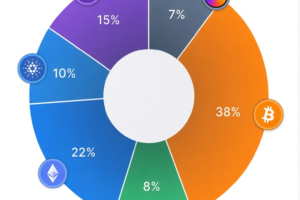
Deciding between Bitcoin and Ethereum does not necessarily have to be an exclusive choice. Many sophisticated investors utilize a blended allocation model, holding both assets in varying proportions depending on their personal risk tolerance and financial objectives.
A common strategy involves establishing a foundational core holding in Bitcoin to capture the digital gold narrative and long-term monetary security, supplemented by an allocation to Ethereum to capture growth driven by utility, smart contract adoption, and application layer revenue. Furthermore, examining historical correlations reveals that while they often move in tandem during macro events, Ethereum frequently outperforms Bitcoin during bullish expansion phases, while Bitcoin tends to preserve capital more effectively during defensive market regimes.
Making Your Final Investment Decision
The choice between Bitcoin and Ethereum ultimately boils down to your core investment thesis. If your goal is to hold a decentralized, censorship-resistant store of value with a fixed monetary supply designed to outlast fiat currency devaluation, Bitcoin stands alone at the pinnacle of the asset class. If your vision of the future involves a decentralized internet powered by smart contracts, programmable money, and global financial applications where you can also earn native staking yields, Ethereum offers unmatched ecosystem dominance.
Evaluating your financial goals, time horizon, and risk appetite will guide you toward the right allocation. Whether you choose the unyielding monetary policy of Bitcoin, the technological utility of Ethereum, or a strategic combination of both, maintaining discipline and a long-term perspective remains essential in the dynamic world of digital finance.