Regular Trading Hours vs. Extended Hours: Key Differences

Navigating financial markets requires a thorough understanding of operational market structure. Stock exchanges do not operate in a vacuum; they function within specific timeframes that dictate liquidity, execution speeds, volatility levels, and price transparency. For modern market participants, decision-making often extends beyond standard exchange schedules into early morning or late afternoon sessions.
The primary choice between placing orders during traditional exchange schedules or utilizing non-standard trading sessions drastically alters trade dynamics. Standard sessions present robust liquidity and tight price spreads driven by high institutional participation. Conversely, non-standard windows offer early access to news releases, earnings reports, and global macroeconomic shifts. Selecting the correct operational window requires analyzing structural mechanics, risk exposure, and order execution guidelines.
Defining Regular Trading Hours in Financial Markets

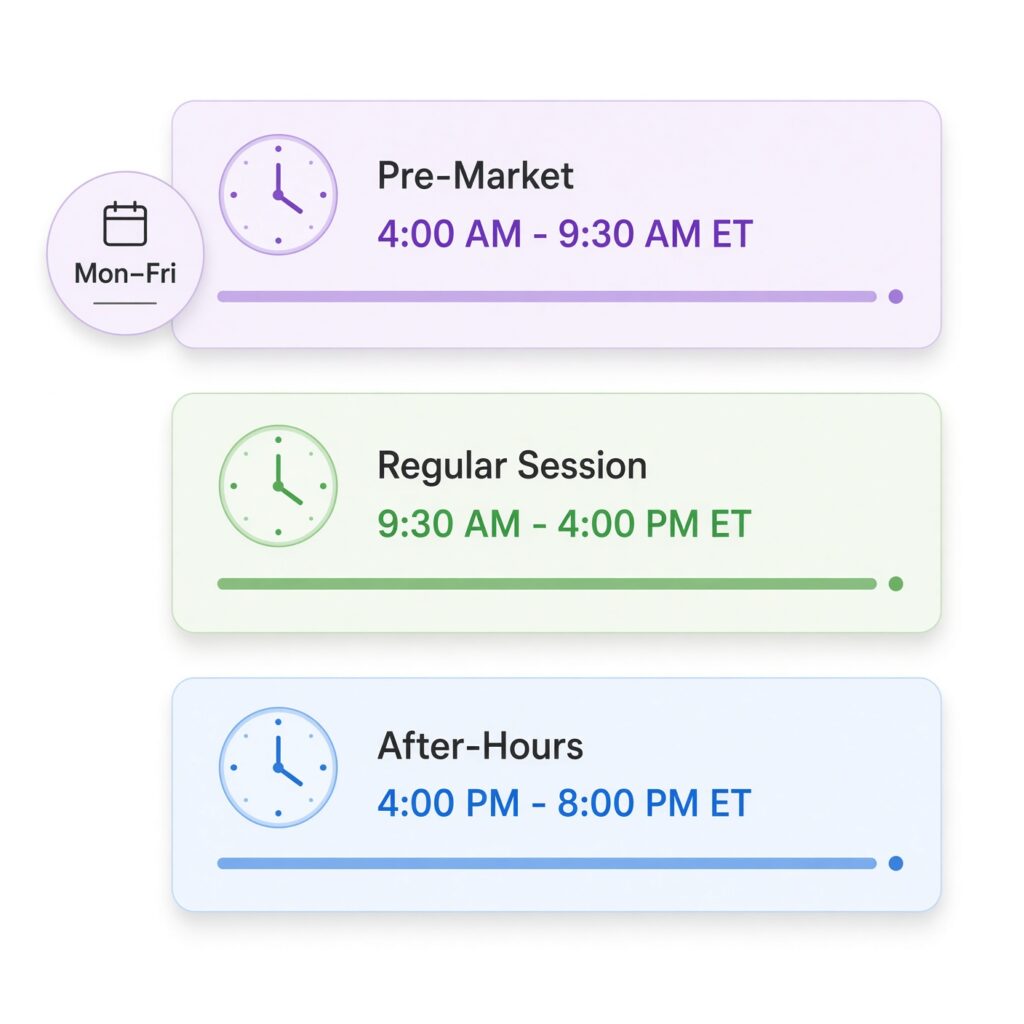
Regular Trading Hours (RTH)—frequently referred to as standard market hours—represent the official session during which primary stock exchanges execute transactions. In major North American equity markets such as the New York Stock Exchange (NYSE) and Nasdaq, RTH spans from 9:30 AM to 4:00 PM Eastern Time (ET).
During RTH, institutional market makers, mutual funds, hedge funds, ETF providers, and retail investors actively participate. This concentration of trading volume provides a stable framework for real-time asset valuation. The official market opening and closing bells anchor the daily trading day, triggering continuous order matching across integrated exchange order books.
+-----------------------------------------------------------------------+
|                       DAILY TRADING SCHEDULE (ET)                      |
+-----------------------------------------------------------------------+
|  04:00 AM - 09:30 AM   |  Pre-Market Session (Extended Hours)         |
|  09:30 AM - 04:00 PM   |  Regular Trading Hours (RTH / Standard)      |
|  04:00 PM - 08:00 PM   |  After-Hours Session (Extended Hours)        |
+-----------------------------------------------------------------------+
Key characteristics defining Regular Trading Hours include:
- High Volume and Deep Liquidity: Millions of shares trade continuously, minimizing delays when converting positions into cash.
- Tight Bid-Ask Spreads: The high volume of active buy and sell orders reduces the spread between bid and ask prices.
- Full Order Type Support: Investors can utilize diverse conditional order types, including market, limit, stop-loss, and trailing-stop orders.
- Centralized Price Discovery: Consolidated Tape systems compile real-time pricing data across all participating national exchanges, ensuring transparent order execution.
Understanding Extended Hours Trading: Pre-Market and After-Hours Sessions
Extended Hours Trading (ETH) encompasses transactions conducted outside standard exchange operation windows. Rather than routing through centralized physical exchange floors, extended sessions rely on Electronic Communication Networks (ECNs). ECNs act as automated alternative trading systems that directly pair buy and sell orders digitally.
Extended hours sessions are divided into two primary operational phases:
1. Pre-Market Session
The pre-market window officially begins as early as 4:00 AM ET and runs until the standard market opening at 9:30 AM ET. Early morning trading allows market participants to react to overnight economic data, geopolitical developments, European market movements, and corporate disclosures published before the bell.
2. After-Hours Session
The after-hours phase commences immediately following the standard market close at 4:00 PM ET and generally extends until 8:00 PM ET. The after-hours window typically experiences substantial spikes in order activity following quarterly corporate earnings announcements, leadership changes, and post-market press releases.
Comparative Structural Breakdown: RTH vs. Extended Hours
To evaluate the operational differences between standard exchange hours and off-peak sessions, market parameters must be analyzed side by side:
| Parameter | Regular Trading Hours (RTH) | Extended Hours Trading (ETH) |
|---|---|---|
| Operational Schedule | 9:30 AM – 4:00 PM ET | Pre-Market: 4:00 AM – 9:30 AM ET After-Hours: 4:00 PM – 8:00 PM ET |
| Execution Infrastructure | Centralized Exchanges (NYSE, Nasdaq) & ECNs | Distributed Electronic Communication Networks (ECNs) |
| Liquidity Level | Extremely High (Institutional Depth) | Significantly Low (Thin Depth) |
| Bid-Ask Spreads | Tight / Narrow | Wide / Expanded |
| Price Volatility | Moderate / Baseline | High / Erratic Price Swings |
| Permitted Order Types | Market, Limit, Stop-Loss, Stop-Limit, Trailing Stops | Strictly Limit Orders (Most Brokerages) |
| Market Participants | Institutional Investors, Market Makers, Retail Investors | High-Frequency Algorithms, Specialized Institutions, Active Retail Traders |
| Order Validity / Expiration | Standard Day, GTC (Good-Til-Canceled), FOK, IOC | Session-Specific Orders (Require Special ETH Designation) |
Key Operational Mechanics and Liquidity Dynamics
Liquidity represents the capability to execute buy or sell orders promptly without causing drastic price movements. In financial markets, liquidity is governed by total volume and market participant density.
                     LIQUIDITY & SPREAD RELATIONSHIP

   Regular Hours:    [ HIGH LIQUIDITY ] ----> [ TIGHT SPREADS ]
   Extended Hours:   [ LOW LIQUIDITY  ] ----> [ WIDE SPREADS  ]
Liquidity Concentration during Regular Hours
During standard hours, continuous order flow creates a dense market environment. Designated Market Makers (DMMs) are legally obligated to maintain orderly markets by continually publishing bid and ask quotes. This structural mandate maintains steady price continuity and minimizes market impact when large blocks of shares are executed.
Thin Order Books during Extended Hours
During extended sessions, institutional volume drops significantly. Without market makers obligated to provide continuous quotes, order books become thin. A relatively small buy or sell order can clear out available price tiers on an ECN, triggering substantial price fluctuations. Consequently, an asset trading quietly during standard hours can experience severe price slippage during pre-market or after-hours sessions.
Bid-Ask Spreads, Volatility, and Price Discovery Execution
Understanding how orders process during different market sessions requires analyzing bid-ask spreads, sudden volatility shifts, and price discovery mechanics.
                           BID-ASK SPREAD VISUALIZATION

    Regular Hours:       $100.00 (Bid) <--- $0.02 Spread ---> $100.02 (Ask)
    Extended Hours:      $ 99.50 (Bid) <--- $1.00 Spread ---> $100.50 (Ask)
Expanded Bid-Ask Spreads
The bid-ask spread reflects the gap between the highest price a buyer is willing to pay and the lowest price a seller is willing to accept.
- RTH Spreads: High transaction volumes create competition among market participants, pulling bids and asks close together—often within pennies or fractions of a cent.
- ETH Spreads: Reduced market participation widens the gap between buyers and sellers. A stock that holds a $0.02 spread during normal hours may experience a spread of $0.50, $1.00, or wider in extended sessions. Widened spreads increase transaction friction and raise immediate entry and exit costs.
Amplified Price Volatility
Price movement velocity accelerates significantly outside standard market hours. With fewer orders sitting in ECN order books, sudden news updates cause sharp price gaps rather than gradual movement. A quarterly earnings report that misses consensus estimates can drive a stock down 15% within seconds during after-hours trading.
Fragmented Price Discovery Across Unlinked Networks
During standard trading hours, price quotes across all domestic exchanges are consolidated via national market system protocols. In extended trading hours, liquidity can become fragmented across separate, unlinked ECNs. As a result, a share of stock might simultaneously quote at slightly different prices on different electronic systems, complicating price assessment.
Market Reaction to Corporate Announcements and Breaking Events
A primary driver of activity during non-standard trading hours is corporate news flow. Public companies deliberately release market-sensitive disclosures outside standard operating hours to give participants time to review data without instantly disrupting the regular trading floor.
+-----------------------------------------------------------------------+
|                    CATALYSTS DRIVING EXTENDED TRADING                  |
+-----------------------------------------------------------------------+
|  Corporate Earnings    |  Released post-close (4:05 PM) or pre-open    |
|  Economic Indicators   |  CPI, Employment Reports released at 8:30 AM  |
|  Geopolitical Events   |  Overnight international market developments  |
|  FDA/Regulatory News   |  Biotech approvals or delays outside RTH      |
+-----------------------------------------------------------------------+
Earnings Releases and Executive Updates
Major listed companies release their quarterly earnings reports either shortly after 4:00 PM ET or prior to 9:30 AM ET. Investors trading during extended sessions can react immediately to metrics such as earnings per share (EPS), revenue performance, and forward revenue guidance.
Economic Data Publications
Government agencies regularly release critical macroeconomic indicators at 8:30 AM ET—one hour before standard trading opens. Key publications include:
- Non-Farm Payrolls (NFP) and Unemployment Rate
- Consumer Price Index (CPI) and Producer Price Index (PPI)
- Gross Domestic Product (GDP) preliminary estimates
- Retail Sales and Consumer Sentiment data
Trading during the pre-market window allows investors to adjust portfolio exposure based on broad economic trends before the opening bell.
Over-Reaction and Morning Reversals
Prices established during extended hours do not always persist into regular market hours. Extended market moves often reflect knee-jerk reactions from aggressive market participants operating in low-volume conditions. When the 9:30 AM ET opening bell rings, massive institutional volume enters the market, often correcting or completely reversing aggressive pre-market price moves.
Risk Assessment: Exposure Factors in Non-Standard Hours
While trading outside standard operating schedules offers early strategic access, it introduces distinct execution risks.
+-----------------------------------------------------------------------+
|                     EXTENDED HOURS TRADING RISKS                      |
+-----------------------------------------------------------------------+
|  [!] Low Liquidity      | Harder to buy or sell positions quickly     |
|  [!] Wide Spreads       | Higher transaction friction and cost        |
|  [!] High Volatility    | Rapid, unpredictable price swings           |
|  [!] Execution Limits   | Mandatory Limit Orders only                 |
|  [!] Information Gap    | Institutional algorithmic advantages        |
+-----------------------------------------------------------------------+
1. Risk of Unfilled or Partially Filled Orders
Due to lower order book depth, limit orders placed during pre-market or after-hours sessions may fail to execute entirely or may only fill partially. If an asset moves rapidly past a specified price threshold, an order can remain pending throughout the session.
2. Absence of Market Orders and Conditional Triggers
To protect investors from severe price execution deviations, brokerage platforms routinely ban standard Market Orders during off-peak sessions. Traders must exclusively submit Limit Orders, specifying the absolute worst price they are willing to accept. Furthermore, stop-loss triggers and trailing-stop features often remain inactive until Regular Trading Hours open, leaving unmonitored positions vulnerable to sudden overnight price drops.
3. Professional and Algorithmic Competition
Extended sessions host a high proportion of institutional quantitative funds, high-frequency trading (HFT) algorithms, and professional prop desks. These entities utilize low-latency execution channels and direct market data feeds that process news releases instantly. Individual retail participants manually entering orders face a structural disadvantage against automated direct-market systems.
4. Over-the-Counter and Illiquid Securities Constraints
While highly capitalized large-cap equities and widely traded index ETFs maintain active extended sessions, smaller equities, micro-caps, and niche exchange-traded products may suffer from non-existent order books outside standard hours. Attempting to trade low-volume securities outside standard operating hours can result in severe price distortion.
Order Types, Execution Rules, and Broker Protocols
Executing trades outside standard schedules requires adhering to specific order handling rules and platform settings.
Limit Order Directives
Because market orders are restricted during non-standard hours, every trade requires an explicit price ceiling or floor:
- Buy Limit Orders: Placed at or below the current offer, ensuring the execution price does not exceed the specified threshold.
- Sell Limit Orders: Placed at or above the current bid, ensuring the trade fills only at or above the designated price.
Time-in-Force (TIF) Designations
Standard orders configured for regular trading hours do not automatically convert into extended-hours orders. Brokerage accounts require market participants to opt-in specifically for off-peak session access.
- Day Session Orders: Default orders placed during the day expire at 4:00 PM ET if unexecuted.
- Extended-Session Orders: Orders specifically tagged for off-peak sessions remain active exclusively during pre-market or after-hours windows. Unfilled extended-session orders typically cancel automatically at 8:00 PM ET rather than carrying over into the following day’s standard session, depending on broker settings.
                      ORDER ROUTING PROTOCOL FLOW

   [ User Order Entry ]
            |
            +---> Select Session Type: [ RTH Only ] vs [ Extended / EXTO ]
            |
            +---> Order Type Check:    [ Limit Order Required for Extended ]
            |
            +---> Route via ECN:       [ Direct Matching Engine ]
Strategic Considerations for Active Market Participants
Choosing whether to trade during regular operating windows or extended sessions depends on an individual’s specific strategy, risk tolerance, and time constraints.
+-----------------------------------------------------------------------+
|                      STRATEGIC PROFILE MATCHING                       |
+-----------------------------------------------------------------------+
|  REGULAR TRADING HOURS (RTH)     |  EXTENDED TRADING HOURS (ETH)      |
|  - Long-term investors           |  - Event-driven active traders     |
|  - High-volume position sizing   |  - Reaction to earnings releases   |
|  - Standard risk profiles        |  - Macro economic news strategy    |
|  - Complex conditional orders    |  - International time-zone alignment|
+-----------------------------------------------------------------------+
When to Trade During Regular Trading Hours
- Executing Large Block Orders: Institutional investors and long-term portfolio managers prefer regular hours to leverage deep liquidity and avoid price impact.
- Utilizing Complex Order Structures: Strategies requiring automated stop-loss protection, trailing stops, or bracketed options strategies must run during standard exchange operations.
- Minimizing Execution Costs: Trades requiring tight bid-ask spreads should be conducted during peak volume windows.
When to Utilize Extended Hours Trading
- Immediate Reaction to News Breaking Outside RTH: Traders seeking to capture early moves or manage exposure ahead of the next day’s open can utilize pre-market or after-hours windows.
- Hedging Overnight Risk: Holding positions ahead of major geopolitical decisions or international regulatory updates may require adjusting positions before standard exchanges open.
- International Participant Accessibility: Market participants operating in distant time zones use extended hours to align market activity with their local daytime schedules.
Summary and Final Implementation Guidance
Understanding the core structural differences between Regular Trading Hours and Extended Hours Trading is fundamental to navigating financial markets efficiently. Standard operating windows offer deep order books, narrow spreads, and centralized price discovery, making them the optimal choice for executing standard trades. Conversely, off-peak pre-market and after-hours sessions offer early reaction capabilities, albeit with lower liquidity, elevated volatility, and wider spreads.
To optimize execution across all session types, consider the following best practices:
- Always Use Limit Orders: Protect trades against erratic price spikes during extended sessions by explicitly defining entry and exit parameters.
- Monitor Spread Widths: Inspect the distance between active bids and asks prior to order submission to prevent unexpected execution costs.
- Scale Down Position Sizes: Use smaller order sizes during extended hours to manage exposure to sudden price moves.
- Verify Opening Continuity: Avoid assuming that pre-market trends will dictate standard market direction; re-evaluate positions as institutional volume enters at the 9:30 AM ET opening bell.