
Which Companies Are Listed on the NYSE vs. Nasdaq?

When investors step into the world of global financial markets, two names dominate the conversation: the New York Stock Exchange (NYSE) and the Nasdaq Stock Market. Both of these powerhouse institutions are located in New York, yet they operate under fundamentally distinct models, execution mechanics, and corporate cultures. Understanding which companies trade on the NYSE versus Nasdaq requires examining how these platforms were built and how their underlying market structures shape corporate decisions.
The New York Stock Exchange, founded in 1792 under the historic Buttonwood Agreement, is the world’s oldest and largest equities exchange by total market capitalization. Historically known for its physical trading floor at 11 Wall Street, the NYSE uses a hybrid auction model. This structure blends high-speed electronic execution with human oversight provided by Designated Market Makers (DMMs). The DMMs maintain market liquidity, dampen extreme price swings, and manage open/close auctions for listed corporate giants.
Conversely, Nasdaq began operations in 1971 as the world’s first electronic stock market. Designed from inception without a physical trading floor, Nasdaq operates as a fully computerized dealer network. Instead of a single assigned market maker, multiple competing dealers enter bids and offers across an automated system. This layout pioneered algorithmic liquidity and established Nasdaq as the natural home for tech-focused enterprises and rapid-growth innovators seeking seamless digital integration.
Evaluating Financial Requirements and Listing Costs Across Exchanges

A primary driver determining where a public company lists is the barrier to entry created by financial thresholds and ongoing corporate maintenance fees. The NYSE has long maintained strict quantitative requirements designed for well-capitalized, seasoned organizations. To earn a listing on the NYSE main board, a company must satisfy demanding criteria:
- Pre-tax Earnings: Aggregate pre-tax earnings of at least $10 million over the prior three fiscal years, with minimum profitability requirements in each consecutive year.
- Market Capitalization: Public float market value thresholds typically starting at $200 million for global standard listings.
- Shareholder Base: A minimum of 400 round-lot shareholders holding 100 or more shares, ensuring widespread public distribution.
- Public Float: At least 1.1 million publicly traded shares outstanding.
Nasdaq offers a multi-tiered corporate structure that caters to a wider array of business lifecycle stages. Divided into the Nasdaq Global Select Market, Nasdaq Global Market, and Nasdaq Capital Market, the exchange provides flexible qualification pathways. Companies can qualify based on equity, market capitalization, total assets, or annual revenue rather than strict historical profitability alone. This accommodates high-burn, fast-scaling companies—such as early-stage biotechnology or emerging software firms—that reinvest heavily in research and development prior to turning a net profit.
Listing and annual fees also showcase a clear distinction. The NYSE charges initial entry fees and annual listing fees based on total share count, often scaling higher than alternative options. Nasdaq structures its fee schedules across its tiers to keep costs manageable for emerging public issuers while scaling up for mega-cap technology leaders.
Analyzing Industry Sector Concentration: Blue Chips vs. Tech Titans
Although both exchanges host multi-industry corporate rosters, distinct sector concentrations have evolved over decades. The listing profiles reflect the underlying heritage of each marketplace.
The NYSE Corporate Profile: Industrials, Financials, and Consumer Staples
The NYSE is traditionally associated with established, cyclical, and dividend-paying blue-chip enterprises. Legacy sectors that form the backbone of global commerce tend to anchor this exchange. Financial institutions, energy conglomerates, aerospace giants, automotive manufacturers, and retail leaders frequently choose the NYSE. These companies often prioritize market stability, institutional governance prestige, and reduced intraday price volatility.
The Nasdaq Corporate Profile: Technology, Biotech, and Growth Capital
Nasdaq is synonymous with modern innovation, digital disruption, and high-growth sectors. Semiconductor designers, cloud software providers, cybersecurity firms, e-commerce networks, and clinical biopharmaceuticals overwhelmingly list on Nasdaq. The platform’s reputation as an incubator for modern technology attracts companies whose valuations are tied to future growth potential, technological IP, and global expansion velocity.
Examining Top Companies Listed on the New York Stock Exchange
The NYSE portfolio features some of the most influential global corporations across real-economy sectors. These organizations maintain substantial physical infrastructure, multi-billion-dollar supply chains, and extensive global operations.
In financial services, legacy institutions such as JPMorgan Chase & Co. (JPM), Bank of America Corp. (BAC), and Berkshire Hathaway Inc. (BRK.A / BRK.B) headline the NYSE ledger. These firms embody the scale, regulatory compliance, and institutional history aligned with the exchange’s heritage.
Consumer staples, pharmaceuticals, and industrial manufacturing are heavily represented:
- The Procter & Gamble Company (PG): A global consumer goods staple that has maintained its NYSE presence for generations.
- The Coca-Cola Company (KO) and PepsiCo, Inc.: Consumer giants relying on broad international retail networks.
- Walmart Inc. (WMT): The world’s largest traditional brick-and-mortar retailer by revenue.
- Eli Lilly and Company (LLY) & Johnson & Johnson (JNJ): Healthcare titans driving medical innovation alongside dividend stability.
- ExxonMobil Corporation (XOM) & Chevron Corporation (CVX): Energy leaders capitalizing on heavy industrial infrastructure.
Examining Top Companies Listed on the Nasdaq Stock Market
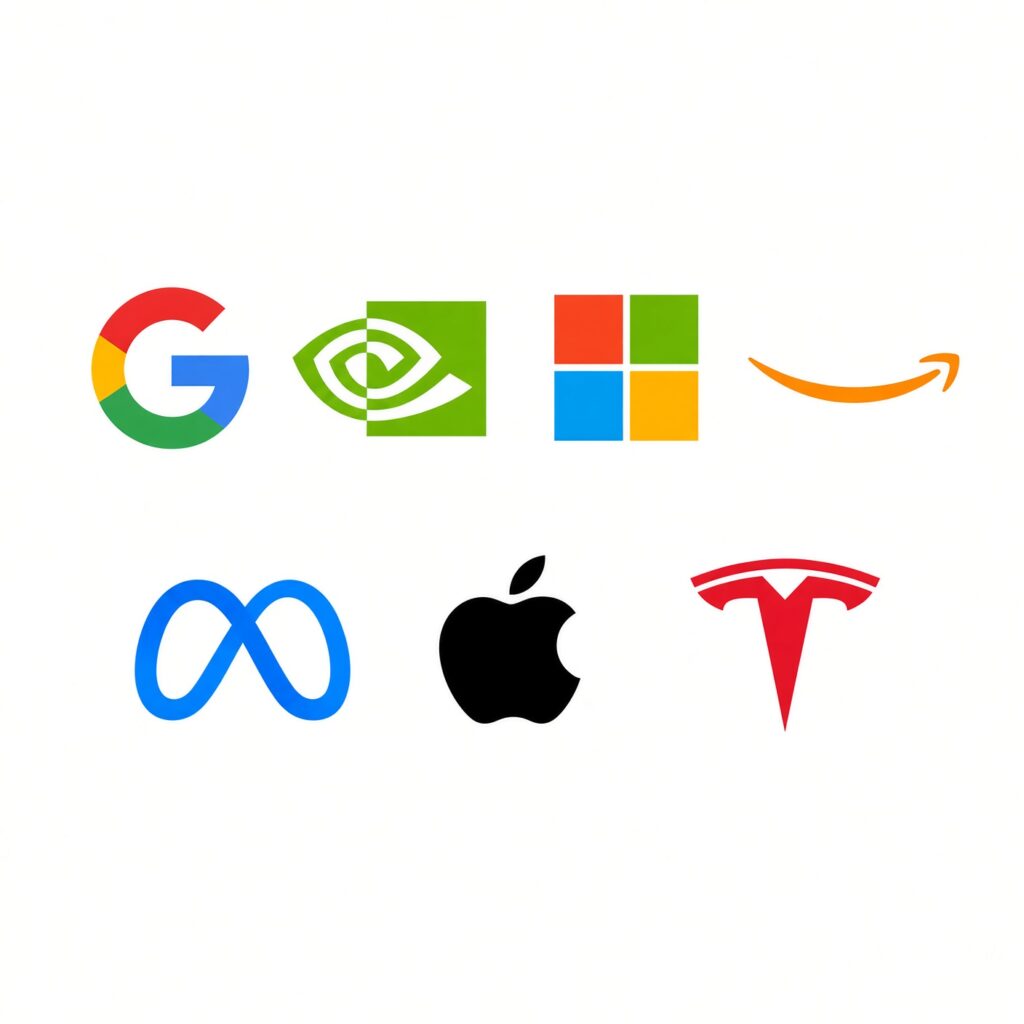
Nasdaq is home to the tech ecosystem and multi-trillion-dollar digital powerhouses. The exchange hosts the core members of the historic mega-cap technology cohort.
Apple Inc. (AAPL) made history as one of Nasdaq’s premier listings, proving how an electronics brand could scale into a multi-trillion-dollar global hardware and services network. Microsoft Corporation (MSFT), which listed on Nasdaq in 1986, exemplifies enterprise software execution and cloud infrastructure expansion.
Other major technological and digital business models listed on Nasdaq include:
- NVIDIA Corporation (NVDA) & Advanced Micro Devices, Inc. (AMD): Semiconductor innovators powering modern artificial intelligence, high-performance computing, and graphics architectures.
- Alphabet Inc. (GOOGL): The parent company of Google, maintaining leadership in search engines, video delivery, and cloud solutions.
- Amazon.com, Inc. (AMZN): The global e-commerce and cloud infrastructure pioneer.
- Meta Platforms, Inc. (META): The dominant social network and digital communications ecosystem.
- Tesla, Inc. (TSLA): The automotive and clean energy disruptor redefining transportation electrification.
Comparing Core Operational Mechanics: Auction vs. Dealer Systems
The structural difference between an auction market and a dealer market directly affects order execution, spread dynamics, and trade routing mechanics.
On the NYSE’s auction platform, buyers and sellers submit competitive bids and offers simultaneously. The Designated Market Maker acts as an impartial central facilitator on the floor, matching buy and sell orders directly. When order imbalances occur—such as during unexpected economic releases or market openings—the DMM uses corporate inventory to absorb excess supply or demand, dampening extreme short-term volatility.
Nasdaq operates a decentralized dealer model. Scores of independent Market Makers maintain active firm quotes to buy and sell specific securities. Orders flow through automated electronic communication networks (ECNs) that route execution to the optimal available price across competing liquidity providers within milliseconds. This environment excels at handling massive order volumes in hyper-liquid stocks, making it ideal for high-frequency trading algorithms.
Exploring Dual Listings, Transfers, and Market Competition Trends
Historically, company exchange assignments were rigid. A firm listed on Nasdaq rarely switched to the NYSE, and dual listings were non-existent. Over the last two decades, intense commercial competition between exchange operators has fundamentally altered these dynamics.
Today, corporate transfers occur frequently. Prominent corporations have migrated from Nasdaq to the NYSE to project long-term maturity or access different institutional index structures. Conversely, several established enterprise brands have transferred from the NYSE to Nasdaq to cut listing fee overhead, gain marketing exposure during tech events, or realign their brand identity with modern digital ecosystems.
Regulations also permit dual listings under specific conditions. While maintaining a primary exchange listing remains the standard practice, regulatory frameworks allow corporate entities to quote their shares across alternate venues to maximize global market access and trading volume options.
Evaluating Key Stock Market Indices and Investment Strategies
Understanding where a company lists clarifies how its equity performance flows into broader market benchmarks and retail investment portfolios.
Major indices maintain strict inclusion guidelines based on exchange listings:
- The Nasdaq-100 Index: Tracks 100 of the largest non-financial domestic and international companies listed exclusively on the Nasdaq stock market. It serves as a core benchmark for technology and growth equity strategies.
- The Nasdaq Composite: A broad index encompassing almost all common stocks listed on the Nasdaq market, heavily weighted toward tech and biotech equities.
- The Dow Jones Industrial Average (DJIA): A price-weighted benchmark composed of 30 blue-chip corporate giants. The DJIA includes stocks listed on both the NYSE and Nasdaq, selecting components based on corporate reputation and sustained growth rather than exchange location.
- The S&P 500 Index: A market-capitalization-weighted index measuring the performance of 500 top publicly traded U.S. companies. It includes qualifying equities from both the NYSE and Nasdaq without listing preference.
Selecting the Ideal Listing Environment for Corporate Growth

When corporate boards evaluate whether to list on the NYSE or Nasdaq during an Initial Public Offering (IPO) or direct listing, they carefully weigh operational factors that extend beyond immediate brand prestige:
- Brand Positioning: Companies seeking association with industrial stability, global legacy operations, and institutional lineage often lean toward the NYSE. Firms positioning themselves as cutting-edge technological innovators lean toward Nasdaq.
- Listing Fee Overhead: Smaller enterprises and early-stage growth companies often evaluate Nasdaq’s tiered market requirements to minimize corporate expenditure during their early public phases.
- Trading Volatility and Execution Preferences: Executing trades within an auction framework supported by a Designated Market Maker provides stability during volatile earnings announcements, while electronic dealer execution prioritizes speed and automated liquidity routing.
Both the NYSE and Nasdaq provide world-class liquidity, strict regulatory oversight via the Securities and Exchange Commission (SEC), and direct access to global capital markets. Ultimately, a company’s choice of exchange serves as a strategic branding statement, financial decision, and operational alignment with its long-term corporate trajectory.