
What Are Pre-Market and After-Hours Stock Trading?

The global financial markets never truly sleep. While the core session of major equity exchanges operates within standard, fixed hours, trading activity frequently continues long before the opening bell rings and long after the official close. This extended activity is split into two primary sessions: pre-market trading and after-hours trading.
Together, these non-standard trading windows are known as extended-hours trading. They allow institutional and retail investors to act on market-moving developments, economic reports, and quarterly earnings outside the traditional session.
Understanding how extended sessions function, how prices are formed, and how risks compound outside regular hours is vital for any trader seeking to navigate modern equity markets.
Defining Extended Hours: What Are Pre-Market and After-Hours Sessions?
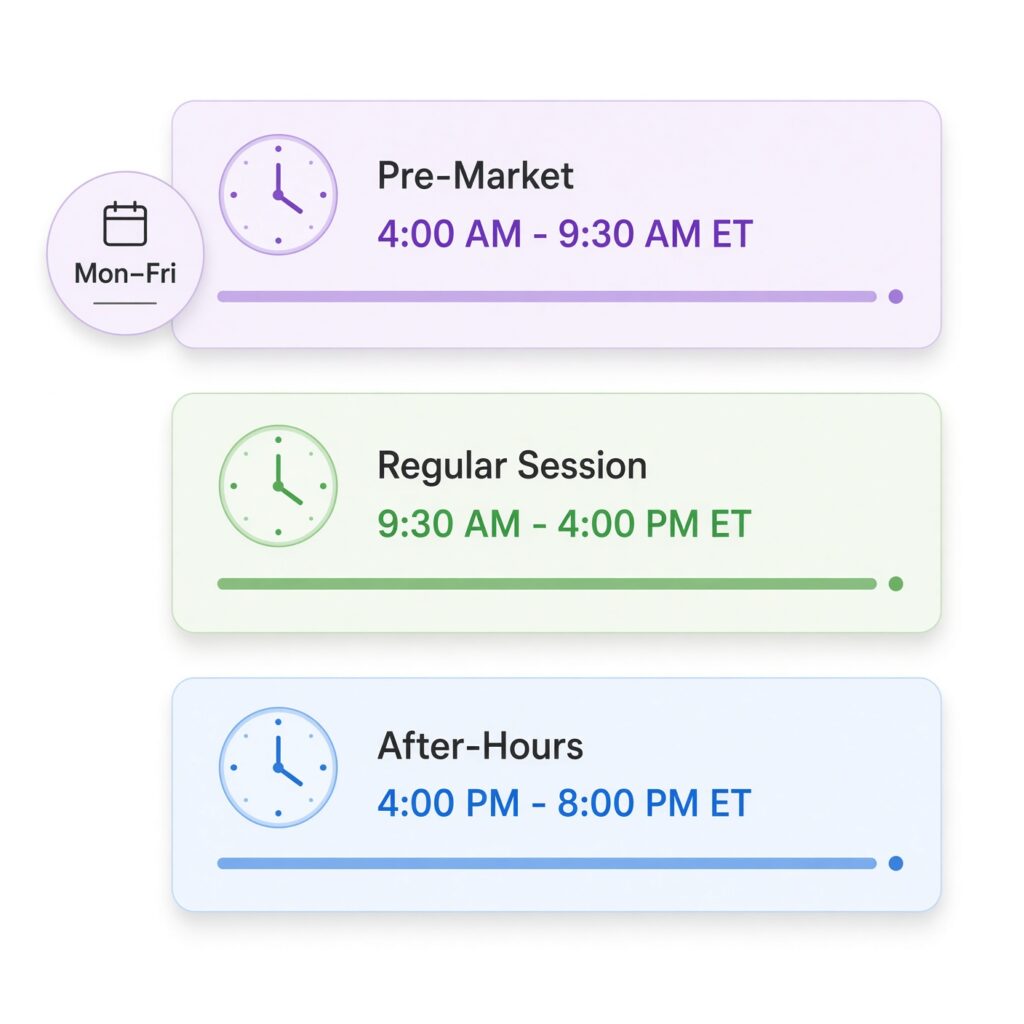
Standard equity trading hours on major stock exchanges typically run from 9:30 AM to 4:00 PM Eastern Time (ET). Extended-hours trading broadens this timeframe, giving participants flexible execution windows.
Pre-Market Trading Hours and Structure
Pre-market trading occurs in the early morning prior to the formal exchange opening.
- Typical Schedule: Pre-market trading can begin as early as 4:00 AM ET and runs until the market opens at 9:30 AM ET. However, the most liquid window occurs between 8:00 AM ET and 9:30 AM ET, as retail brokerages open order access and economic indicators are released.
- Core Purpose: The pre-market session serves as a price discovery arena where market participants digest overnight global events, foreign market shifts, political headlines, and early morning corporate announcements.
After-Hours Trading Hours and Structure
After-hours trading takes place immediately following the closing bell.
- Typical Schedule: The after-hours session generally starts at 4:00 PM ET and can extend until 8:00 PM ET. The highest volume typically occurs within the first hour (4:00 PM to 5:00 PM ET), coinciding with quarterly earnings releases and management guidance calls.
- Core Purpose: This session gives traders an immediate channel to react to news released after market close, preventing the need to hold positions unmanaged until the next morning’s open.
How Extended-Hours Stock Trading Works Under the Hood
During normal market hours, central exchanges like the New York Stock Exchange (NYSE) or Nasdaq execute orders through centralized order books and designated market makers. Extended-hours trading functions through a decentralized infrastructure.
The Role of Electronic Communication Networks (ECNs)
Extended trading relies almost entirely on Electronic Communication Networks (ECNs). ECNs are automated digital systems that match buy and sell orders directly between buyers and sellers without traditional exchange intermediaries.
Because multiple independent ECNs operate concurrently during extended hours, order flow can become fragmented. An order submitted on one ECN may not interact with liquidity on another ECN, leading to instances where different platforms display slightly varying bid and ask quotes for the exact same stock.
Order Types Allowed: The Dominance of Limit Orders
Execution parameters during extended hours differ significantly from regular market sessions.
Most brokers restrict extended-hours trading strictly to limit orders. Market orders, which execute immediately at the best available price, are generally blocked by brokerage risk controls during these times. Limit orders protect traders by ensuring that a order will only execute at a specified price or better, guarding against the wild price fill slippage common in low-liquidity environments.
Key Drivers: What Causes Massive Moves Outside Regular Hours?
Stock prices move in response to fresh information. Because major public companies and government statistical agencies strategically release information outside standard trading hours to minimize intra-day panics, extended sessions often experience the sharpest price swings.
| Catalyst Event | Typical Time Frame | Extended Session Impact |
|---|---|---|
| Quarterly Earnings Reports | 4:00 PM – 4:30 PM ET | Triggers immediate, high-volume price repricing in after-hours. |
| Key Economic Data (CPI, Jobs Report) | 8:30 AM ET | Causes sharp index futures and individual stock revaluations in pre-market. |
| FDA Approvals & Regulatory News | Overnight / Pre-Market | Can lead to massive gap ups or gap downs before the opening bell. |
| Overnight International Markets | 12:00 AM – 6:00 AM ET | Asian and European market trends set early sentiment for U.S. equities. |
| Analyst Upgrades / Downgrades | 6:00 AM – 8:00 AM ET | Institutional research notes alter pre-market buying and selling pressure. |
Quarterly Corporate Earnings Announcements
The vast majority of public corporations publish their earnings reports either shortly before 9:30 AM ET or right after 4:00 PM ET. A surprise beat or miss on earnings per share (EPS), revenue, or forward guidance instantly shifts valuation assumptions, causing rapid repricing in after-hours trading.
Macroeconomic Data Releases
Economic statistics—such as Non-Farm Payrolls, Consumer Price Index (CPI) inflation metrics, and Gross Domestic Product (GDP) updates—are regularly published at 8:30 AM ET. Pre-market traders adjust their positions in real time based on how these figures might influence interest rate expectations and broader market health.
Major Advantages of Trading During Extended Hours

For disciplined market participants, extended hours offer strategic benefits that are unavailable during the standard trading day.
1. Fast Reaction Time to Real-Time News
The primary benefit of extended trading is the ability to trade immediately on breaking news. If a company announces a major acquisition or management change at 5:00 PM ET, extended-hours access allows investors to enter or exit a position right away rather than waiting for tomorrow’s opening bell.
2. Risk Management and Position Hedging
Investors holding large overnight exposures can use extended hours to hedge risk. If an earnings report from an industry competitor signals sector-wide weakness, a trader can reduce risk across related holdings during the after-hours session to avoid larger opening gaps the next morning.
3. Convenience for Flexible Schedules
Extended sessions accommodate investors located in different time zones or those with busy daily schedules who cannot actively monitor the markets during normal business hours.
Critical Risks and Challenges of Extended-Hours Trading
While the flexibility of pre-market and after-hours trading is appealing, these sessions carry heightened operational and financial risks compared to standard market hours.
Reduced Market Liquidity
Liquidity refers to how easily assets can be bought or sold without causing dramatic price changes. Because fewer institutional participants actively trade during extended hours, overall volume is a fraction of the regular session. Lower volume means fewer active buyers and sellers, making it harder to fill large position sizes smoothly.
Substantially Wider Bid-Ask Spreads
The bid-ask spread is the gap between the highest price a buyer is willing to pay and the lowest price a seller is willing to accept. Reduced liquidity causes this spread to widen significantly outside regular hours. A stock with a $0.01 spread during regular hours might exhibit a $0.50 or $1.00 spread in after-hours trading, raising the cost of entering and exiting trades.
Extreme Price Volatility
With fewer orders resting in ECN order books, even modest buy or sell orders can move a stock’s price substantially. Price action in extended hours can be violently erratic, characterized by sudden spikes or sharp drops that may not reflect true fundamental value.
Phantom Moves and Opening Reversals
One of the most common pitfalls for retail traders is assuming extended-hours prices will hold when the regular session opens. It is frequent for a stock to rally 8% in after-hours trading on earnings, only to reverse completely by the next day’s 9:30 AM open as larger institutional flow enters the market and reassesses the results. Extended-hours price movements should always be viewed as provisional.
Pre-Market vs. After-Hours vs. Regular Hours: Comparison Analysis
To gain a clear view of how market sessions differ, consider this side-by-side comparison of execution parameters:
| Operational Feature | Pre-Market Trading | Regular Market Hours | After-Hours Trading |
|---|---|---|---|
| Typical Time Window | 4:00 AM – 9:30 AM ET | 9:30 AM – 4:00 PM ET | 4:00 PM – 8:00 PM ET |
| Primary Participation | Early retail, global institutions | All market participants | Active traders, earnings participants |
| Liquidity Depth | Low to Moderate | Maximum (Deepest order books) | Low to Moderate |
| Average Bid-Ask Spread | Wide | Tight / Competitive | Wide |
| Price Volatility | Elevated | Standard / Controlled | Elevated |
| Execution Networks | ECN Networks | Primary Exchanges & ECNs | ECN Networks |
| Accepted Order Types | Primarily Limit Orders | Market, Limit, Stop, Complex | Primarily Limit Orders |
Essential Rules for Trading in Extended Sessions
Navigating pre-market and after-hours trading requires strict risk management and execution discipline. Implementing specific trading rules helps minimize the structural disadvantages of trading in low-volume sessions.
Always Use Limit Orders
Never attempt to execute a trade during extended hours without using a limit order. A limit order specifies the exact maximum price you are willing to pay for a buy order or the minimum price you are willing to accept for a sell order. This prevents execution at an unfavorable price caused by wider bid-ask spreads.
Reduce Position Sizing
Because extended-hours markets feature thinner liquidity and higher volatility, order sizing should be scaled down relative to regular session trades. Trading smaller quantities allows for faster execution and reduces the risk of partial order fills.
Verify Brokerage Extended-Hours Execution Rules
Different brokerages enforce varying guidelines regarding extended-hours trading.
- Some platforms require investors to manually opt-in or sign specific risk disclosures before enabling extended-hours access.
- Commission structures, order routing behavior, and exact trading hours vary across brokers.
- Orders placed during extended hours do not automatically carry over into the regular session unless explicitly submitted with session-specific order flags (such as “EXT” or “GTC + Extended”).
Avoid Illiquid Tickers
Stick to highly liquid, mega-cap stocks or widely traded index Exchange Traded Funds (ETFs) during extended sessions. Small-cap or thinly traded equities during regular hours become even harder to trade in after-hours, often resulting in massive price slippage or completely unfilled orders.
Final Insights on Extended-Hours Trading
Pre-market and after-hours trading sessions provide invaluable avenues for managing portfolio risk and acting on corporate earnings, economic reports, and global events in real time. They allow active traders to stay ahead of market trends before the official opening bell rings.
However, the advantages of early access come with clear operational challenges: lower liquidity, wider bid-ask spreads, and heightened volatility. By utilizing limit orders, reducing position sizes, and maintaining realistic expectations about price continuity into the main session, traders can safely navigate extended hours while protecting their trading capital.