Common Cryptocurrency Terms Every Beginner Should Know

Stepping into the world of cryptocurrencies can feel like walking into a foreign country where everyone is speaking a completely different language. Between discussions of “bull runs,” “HODLing,” and “blockchain gas fees,” it is easy for beginners to feel overwhelmed and take a step back before they even get started.
Understanding the basic vocabulary is the single most important step you can take. Not only does it protect you from costly mistakes and scams, but it also empowers you to make informed decisions about your digital assets. This comprehensive guide breaks down the essential cryptocurrency terms every beginner needs to know, explained in plain, accessible English without the confusing jargon.
What is Cryptocurrency? The Foundation of Digital Money
At its core, a cryptocurrency is a digital or virtual form of currency that uses cryptography for security, making it extremely difficult to counterfeit. Unlike traditional money issued by governments (such as the U.S. Dollar or the Euro), cryptocurrencies typically operate on decentralized networks using blockchain technology.
- Fiat Currency: Government-issued money that is not backed by a physical commodity like gold. Examples include the US Dollar (USD), Euro (EUR), and British Pound (GBP). Traditional finance is often referred to as “TradFi.”
- Coins vs. Tokens: While often used interchangeably, there is a technical difference. A coin (like Bitcoin or Ethereum) operates on its own independent blockchain. A token (like Uniswap or Chainlink) is built on top of an existing blockchain (most commonly Ethereum) and is usually created to power a specific decentralized application or project.
- Altcoin: Short for “alternative coin,” this term refers to any cryptocurrency other than Bitcoin. Because Bitcoin was the first, every cryptocurrency that followed it is technically an altcoin.
Understanding Blockchain Technology: The Digital Ledger
You cannot truly understand cryptocurrency without understanding the technology that powers it. Think of blockchain as a digital spreadsheet or ledger that is shared across a vast network of computers.
- Decentralization: Unlike a traditional bank account managed by a single central authority, a decentralized network distributes control across thousands of independent computers (nodes). No single entity can freeze your funds or alter past transactions.
- Distributed Ledger Technology (DLT): A database that is consensually shared and synchronized across multiple sites, institutions, or geographies. Every transaction is recorded simultaneously across the network.
- Nodes: The individual computers connected to a blockchain network that validate, store, and relay transaction data. By running a node, participants help secure the network.
- Immutability: Once a block of data is added to the blockchain, it becomes nearly impossible to change or delete. This creates a permanent, tamper-proof history of all transactions.
How Transactions Work: Mining, Staking, and Consensus
How do transactions actually get approved without a bank? Cryptocurrencies rely on consensus mechanisms—rules that network participants use to agree on the validity of transactions.
- Mining: The process used by proof-of-work blockchains (like Bitcoin) where powerful computers solve complex mathematical puzzles to verify transactions and secure the network. Successful miners are rewarded with newly minted cryptocurrency.
- Proof of Work (PoW): The original consensus mechanism requiring miners to expend significant computational power (and electricity) to validate transactions and protect the network against attacks.
- Proof of Stake (PoS): An energy-efficient alternative to mining where participants (“validators”) lock up a certain amount of their cryptocurrency (their “stake”) to help verify transactions and earn passive rewards.
- Gas Fees: Transaction fees paid to network validators (miners or stakers) on networks like Ethereum to compensate for the computational energy required to process and execute smart contracts or transfers.
Wallets and Security: Keeping Your Digital Assets Safe
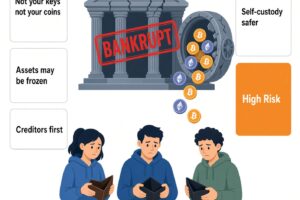
One of the scariest parts for beginners is figuring out how to store cryptocurrency safely. In crypto, you are your own bank, which means security is entirely in your hands.
- Public Key (Public Address): Think of this as your digital bank account number or email address. It is safe to share with others so they can send you funds.
- Private Key: Think of this as your digital signature or password. It grants access to the funds at your public address. Never share your private key with anyone, because whoever holds the private key owns the crypto.
- Hot Wallet: A cryptocurrency wallet connected to the internet (such as mobile apps or browser extensions). They are convenient for daily trading and frequent transactions, but slightly more vulnerable to online attacks.
- Cold Wallet (Hardware Wallet): A physical device (resembling a USB flash drive) that stores your private keys completely offline. This is considered the safest method for storing large amounts of cryptocurrency long-term.
- Seed Phrase (Recovery Phrase): A sequence of 12 to 24 random words generated when you set up a crypto wallet. If your phone or computer breaks, your seed phrase is the only way to recover your assets. Store it on paper in a secure place—never save it digitally in screenshots or cloud notes.
Market Dynamics and Trading Terminology
When you start browsing crypto news or price charts, you will encounter a unique slang born from internet culture and traditional finance.
- Bull Market: A prolonged period of rising prices and high investor optimism.
- Bear Market: A prolonged period of falling prices and negative market sentiment.
- HODL: A misspelling of “hold” that originated from a legendary forum post in 2013. In the crypto community, it means holding onto your cryptocurrency through market volatility rather than panic-selling.
- FOMO (Fear Of Missing Out): The anxious feeling that you are missing out on potential profits when a coin’s price skyrockets, often leading impulsive buyers to purchase at market peaks.
- FUD (Fear, Uncertainty, and Doubt): Disinformation or negative sentiment spread intentionally by market participants or media outlets to drive down asset prices.
- Market Capitalization (Market Cap): The total dollar value of a cryptocurrency. It is calculated by multiplying the current price of a single coin by the total number of coins in circulation.
- Liquidity: How easily a cryptocurrency can be bought or sold for cash or other digital assets without drastically affecting its market price.
Advanced Concepts Made Simple: DeFi, Smart Contracts, and NFTs
As you grow more comfortable, you will encounter ecosystem terms that represent the cutting edge of financial technology.
- Smart Contracts: Self-executing digital contracts written directly into lines of code on a blockchain. They automatically execute transactions when predetermined conditions are met, eliminating the need for middlemen like lawyers or brokers.
- DeFi (Decentralized Finance): An umbrella term for financial services—such as lending, borrowing, and earning interest—built on public blockchains, operating entirely without traditional centralized institutions like banks.
- NFT (Non-Fungible Token): A unique digital certificate stored on a blockchain that proves ownership of a specific digital asset, such as digital art, music, or virtual real estate. Unlike Bitcoin, which is fungible (each Bitcoin is identical and interchangeable), every NFT is completely unique.
- DEX (Decentralized Exchange): A peer-to-peer marketplace where users can trade cryptocurrencies directly with one another without handing over custody of their funds to a centralized intermediary company.
Your Next Steps in the Crypto Journey
Entering the cryptocurrency space does not require a degree in computer science or finance. By mastering these foundational terms—from understanding the importance of cold wallets and seed phrases to recognizing market sentiment indicators like HODL and FUD—you are well-equipped to navigate the ecosystem safely and confidently.
Take your time, prioritize security above all else, and never invest money you cannot afford to lose as you explore this exciting technological frontier.