How Does Bitcoin Halving Affect Mining Rewards?

If you are exploring the world of cryptocurrencies, you have likely heard whispers about the Bitcoin halving and its massive impact on the digital asset ecosystem. While crypto enthusiasts often focus on how halvings affect market prices, another crucial part of the puzzle unfolds behind the scenes: Bitcoin mining rewards.
For beginners looking to understand the mechanics powering the world’s leading cryptocurrency, grasping how mining rewards shift during a halving is essential. This guide breaks down the core concepts in plain English, explaining how the halving works, what happens to miner revenues, and why this programmed event dictates the entire economic structure of Bitcoin.
What Is a Bitcoin Halving and Why Does It Happen?
To understand mining rewards, we first need to look at how Bitcoin is created. Unlike traditional fiat currencies—such as the US Dollar, which central banks can print indefinitely—Bitcoin has a strict, hard-coded supply limit of 21 million coins.
New Bitcoins are not issued by a government or a company. Instead, they enter circulation as a reward given to decentralized network participants known as miners. These miners use specialized, high-powered computers to solve complex cryptographic puzzles, validate transactions, and secure the blockchain network via a mechanism called Proof of Work.
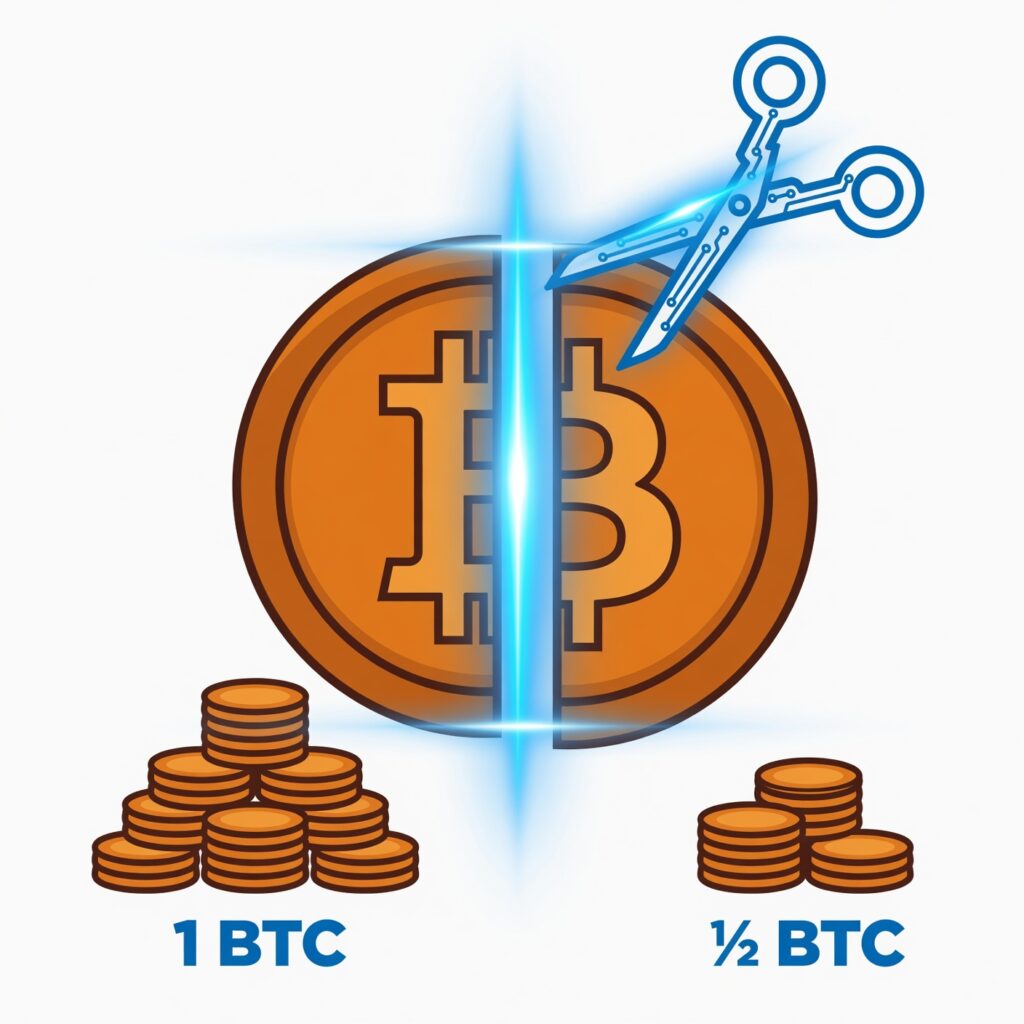
To control inflation and systematically mimic the scarcity of precious metals like gold, Bitcoin’s anonymous creator, Satoshi Nakamoto, baked a specific rule into the protocol: every 210,000 blocks (roughly every four years), the amount of new Bitcoin created per block is cut precisely in half. This predictable supply reduction is what the crypto community calls the halving.
The Mechanics of Bitcoin Mining Rewards: Subsidy vs. Transaction Fees
When a miner successfully validates a new block of transactions and adds it to the public ledger, they are compensated through total block revenue. This revenue is composed of two distinct components:
- The Block Subsidy: Newly minted Bitcoins created out of thin air by the protocol as a reward for securing the network. This is the part that gets cut in half during a halving event.
- Transaction Fees: Small fees paid by users to have their transfers processed quickly and prioritized inside that block.
Before any halving takes place, the block subsidy makes up the lion’s share of a miner’s income. However, because the subsidy drops by 50% every four years, the long-term survival of mining operations relies heavily on how transaction fees scale over time.
Historical Overview: How Past Halvings Changed the Mining Landscape
The Bitcoin network has experienced multiple halving cycles since its inception, each reshaping miner economics:
- The Genesis Era & First Halving (2012): When Bitcoin launched in 2009, miners received 50 BTC per block. On November 28, 2012, at block height 210,000, the reward dropped to 25 BTC. At the time, Bitcoin was a niche asset, but the reduction initiated the protocol’s deflationary design in real-world conditions.
- The Second Halving (2016): The reward decreased from 25 BTC to 12.5 BTC per block. This era saw the rise of large-scale industrial mining facilities as ordinary computer hardware could no longer compete efficiently.
- The Third Halving (2020): The subsidy was cut from 12.5 BTC to 6.25 BTC right in the middle of global economic shifts. Miners faced intense efficiency pressures, driving many to seek cheap, renewable energy sources.
- The Fourth Halving (2024): Occurring on April 20, 2024, the reward was slashed from 6.25 BTC down to the current 3.125 BTC per block.
Each of these historical milestones forced inefficient operations to shut down while rewarding innovation, hardware upgrades, and strategic energy sourcing.
Immediate Effects on Miner Profitability and Operational Costs
When the block subsidy is abruptly cut in half, miners experience an immediate squeeze on their gross revenue. Unless the market price of Bitcoin compensates for the drop by rising significantly, profit margins shrink overnight.
- The Hardware Efficiency Race: Following a halving, older, less power-efficient mining rigs (like older generation ASIC miners) instantly become unprofitable to run because the electricity cost to operate them exceeds the value of the rewards they generate.
- The Hashrate Adjustment: If a large number of unprofitable miners turn off their machines, the network’s total computational power (known as the hashrate) drops. Fortunately, Bitcoin’s code features an automatic difficulty adjustment mechanism. Roughly every two weeks, the network recalculates how hard it is to mine a block, making puzzles easier if miners leave, or harder if more join. This ensures blocks continue to be found every ten minutes on average.
- Operational Consolidation: Smaller hobbyist miners often find post-halving environments difficult to navigate, leading to a consolidation of mining power among large corporate mining enterprises that benefit from economies of scale and cheap long-term energy contracts.
The Transition to Transaction Fees: The Long-Term Future

Because the block subsidy halves every four years, the math dictates that the final Bitcoin will be mined around the year 2140. At that point, the block subsidy will reach zero, and new issuance will completely stop.
So, what will incentivize miners to keep the network secure once there are no new Bitcoins left to claim?
The answer lies in transaction fees. As adoption grows and network congestion increases during periods of high demand, users willingly attach higher satoshi-per-byte fees to their transactions to ensure swift confirmation. Over successive halving cycles, transaction fees naturally grow to form a larger percentage of total miner revenue. Eventually, transaction fees are expected to fully replace the block subsidy, creating a self-sustaining economic model for network security that operates independently of new coin issuance.
Why the Halving Matters for the Ecosystem
The Bitcoin halving is much more than a routine code update; it is the heartbeat of Bitcoin’s monetary policy. By systematically reducing mining rewards, the protocol enforces absolute digital scarcity.
While the sudden drop in block rewards creates temporary economic stress for miners—forcing a continuous cycle of technological upgrades, energy optimization, and market consolidation—it ultimately strengthens the network’s decentralized security model. For anyone looking to understand cryptocurrency economics, recognizing how mining rewards adapt to halvings provides a clear window into why Bitcoin continues to function as a resilient, self-governing financial asset.