What Are Public and Private Keys in Cryptocurrency?

Cryptocurrency has revolutionized how we think about money, ownership, and digital transactions. Unlike traditional banking, where a central authority like a bank or government manages your funds, cryptocurrencies operate on decentralized networks. But this raises a fundamental question: If there is no bank to keep your password safe, how do you protect your digital assets?
The answer lies in a clever piece of cryptography known as public and private keys.
If you are new to the world of digital currencies, terms like “cryptography,” “keys,” and “blockchain” can sound intimidating. However, the core concept is surprisingly simple once you break it down. Think of your public and private keys as a digital equivalent of a bank account number and a secret PIN—except they work together using advanced mathematics to ensure that only you have absolute control over your money.
In this comprehensive guide, we will demystify what public and private keys are, how they work together, why they are essential for your security, and how you can manage them safely. By the end of this article, you will have a clear understanding of the backbone of cryptocurrency security.
What is Cryptography in the World of Digital Currencies?

To understand keys, we first need to touch upon the technology that makes them possible: cryptography. The word cryptography comes from ancient Greek roots meaning “secret writing.” In the digital age, it refers to the science of securing information by transforming it into unreadable formats that can only be unlocked by the intended recipient.
In cryptocurrency, cryptography serves two main purposes:
- Verifying ownership: Proving that you are the rightful owner of the funds you want to send.
- Securing transactions: Ensuring that once a transaction is recorded on the blockchain, it cannot be altered, hacked, or forged.
Without cryptography, digital currencies would not be secure. Anyone could copy, paste, and steal digital money just like a digital photo. Cryptography ensures that digital scarcity exists, meaning a coin or token can only be owned by one person at a time and transferred only with the owner’s explicit permission.
The Digital Analogy: Understanding Public and Private Keys
To make public and private keys easy to understand, let’s use a real-world analogy that everyone is familiar with: a physical mailbox.
The Public Key as a Mailbox Slot
Imagine a secure mailbox standing on a public street. Anyone walking by can see the slot where letters can be dropped in.
- People can look at the slot (your public key).
- They can place a letter or a check inside the slot (send you funds).
- However, once the mail is dropped in, no one can reach back inside to pull things out through that slot.
In cryptocurrency, your public key is transformed into your public address (often represented as a long string of letters and numbers or a QR code). You share this address with friends, family, or clients when you want them to send you cryptocurrency. It is entirely safe to share publicly.
The Private Key as the Mailbox Key
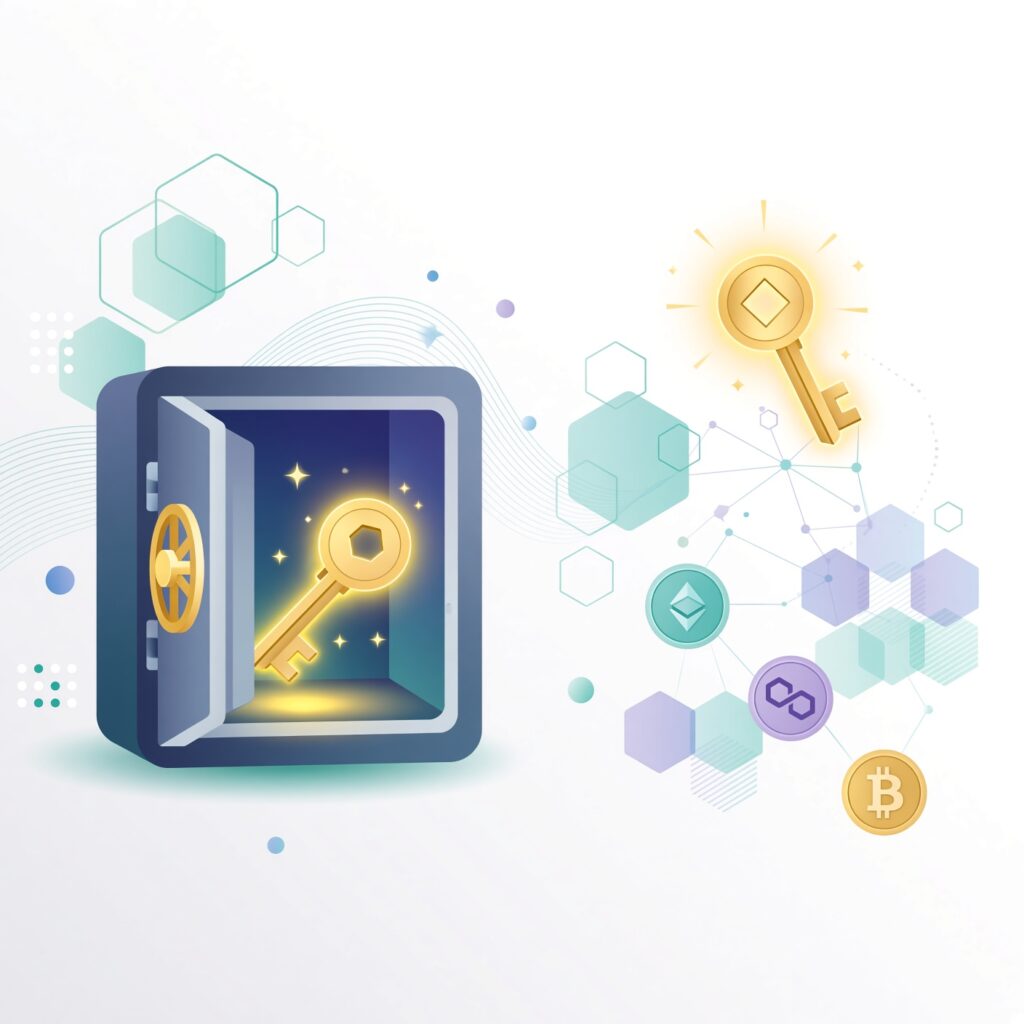
Now, imagine the small metal key that unlocks the door at the back of the mailbox.
- Only you possess this physical key (your private key).
- With this key, you can open the door, access everything inside, and manage your mail.
- If you lose this key, you can never open the mailbox again. If someone else steals this key, they gain access to everything inside.
Your private key is your ultimate digital signature and proof of ownership. It grants you the absolute authority to authorize transactions and move your crypto out of your wallet. Never share your private key with anyone.
How Public and Private Keys Work Together
Behind the scenes, public and private keys are mathematically linked through an advanced process called Asymmetric Cryptography. This means that while the two keys are mathematically related, it is practically impossible to figure out what your private key is just by looking at your public key.
Here is how the process flows step-by-step when you send cryptocurrency to someone else:
1. Generating Your Keys
When you set up a cryptocurrency wallet (such as MetaMask, Trust Wallet, or a hardware wallet like Ledger), the software generates a unique pair of keys for you using a random number generator.
2. Receiving Funds
When someone wants to send you Bitcoin, Ethereum, or any other digital asset, you give them your public address (derived from your public key). They use this address as the destination for the transaction on the blockchain network.
3. Initiating a Transaction
When you want to send cryptocurrency to someone else, your wallet software uses your private key to sign a digital message. This cryptographic signature proves mathematically that the owner of the private key authorized the transfer, without actually revealing the private key itself.
4. Network Verification
The decentralized blockchain network takes your public key, checks the digital signature created by your private key, and verifies that you actually have the funds you are trying to send. Once verified, the transaction is permanently recorded on the blockchain ledger.
The Core Differences Between Public and Private Keys
To ensure absolute clarity, let’s compare the two side-by-side:
| Feature | Public Key (Public Address) | Private Key |
|---|---|---|
| Primary Function | Receiving funds and sharing with others | Authorizing transactions and proving ownership |
| Visibility | Public (safe to share with anyone) | Private (must be kept secret at all times) |
| Analogy | Bank account number or email address | Account password or physical mailbox key |
| Risk of Exposure | Low (people can only send you money) | Critical (anyone can steal your funds) |
| Derivation | Generated from the private key via math | Randomly generated master seed |
Why Wallet Security Depends Entirely on Your Private Key
In the traditional financial world, if you forget your online banking password, you click “Forgot Password,” verify your identity via email or SMS, and reset it. A customer service representative can restore your access.
In decentralized cryptocurrency, there is no customer service center. There is no central bank, no CEO, and no password-reset button.
Because blockchains are decentralized and trustless, security is placed entirely in your hands. If you lose your private key or the backup recovery phrase (often called a seed phrase) that generates your private keys, your funds are gone forever. No one on earth can recover them for you.
Conversely, if a malicious actor gains access to your private key, they can instantly transfer all your cryptocurrency to their own wallets, and because blockchain transactions are irreversible, you have no way to reverse or cancel the transfer.
Common Misconceptions About Cryptocurrency Keys
As people enter the world of digital assets, several common myths and misunderstandings tend to pop up. Let’s clear them up.
Myth 1: “My Cryptocurrency is Stored Inside My Public Address”
Many beginners believe that coins and tokens are physically stored inside their wallet address or inside their private key. In reality, your cryptocurrency never leaves the blockchain. The blockchain is a public, distributed ledger that records every transaction ever made. Your public and private keys simply prove that you have the authority to update the ledger entries associated with your specific address.
Myth 2: “If I Change My Wallet App, My Keys Stay the Same”
Your wallet app is simply a tool or a window used to interact with the blockchain. The actual keys belong to the cryptographic mathematics behind your seed phrase (usually a sequence of 12 or 24 random English words). If you delete an app but write down your seed phrase correctly, you can restore your wallet on any compatible device and regain full access to your funds.
Myth 3: “Public Keys and Addresses Are the Exact Same Thing”
While they are closely related, a public address is usually a hashed, shortened version of your raw public key. Think of the public key as your full legal name, and the public address as your convenient email handle used for everyday communication.
Best Practices for Managing and Protecting Your Keys
Because protecting your private keys is the single most important responsibility of owning cryptocurrency, following strict security habits is essential. Here are industry-standard best practices to keep your digital assets safe:
1. Write Down Your Seed Phrase on Paper
When setting up a self-custody wallet, you will be given a backup seed phrase (12 to 24 words). Write these words down on a physical piece of paper or stamp them onto a metal backup plate. Never take a screenshot, save them in a notes app on your phone, or upload them to cloud storage where hackers could potentially find them.
2. Use Hardware Wallets for Long-Term Storage
Software wallets (hot wallets connected to the internet via browsers or mobile apps) are convenient for everyday trading, but they carry higher risks of malware or phishing attacks. For substantial holdings, invest in a hardware wallet (cold storage) like a Ledger or Trezor. Hardware wallets keep your private keys completely offline, isolated from internet threats.
3. Beware of Phishing Scams
Scammers often set up fake websites that mimic popular crypto wallets or exchanges, asking you to “verify” or “import” your private keys or seed phrase. Legitimate projects, developers, and support teams will never ask for your private key or seed phrase. If anyone asks for your private key, they are attempting to steal from you.
4. Enable Two-Factor Authentication (2FA) Everywhere
If you use centralized platforms alongside your self-custody wallets, always enable robust security measures such as authenticator apps (e.g., Google Authenticator) rather than SMS-based verification, which can be vulnerable to SIM-swap attacks.
Empowering Your Crypto Journey with Knowledge

Understanding public and private keys is the ultimate rite of passage for anyone stepping into the cryptocurrency ecosystem. By grasping how these two cryptographic elements work together—one acting as your open mailbox slot for receiving funds, and the other as your secret key for authorizing transactions—you gain the confidence to navigate the digital economy safely.
Decentralization offers unprecedented financial freedom, but it also demands personal responsibility. By treating your private keys and seed phrases with the highest level of security, you ensure that your digital assets remain truly yours.
As you continue exploring the fascinating world of blockchain technology, remember that security is not a one-time setup, but an ongoing habit. Stay informed, stay cautious, and enjoy taking control of your financial future!