How Does Blockchain Technology Work?

Imagine a digital notebook that is shared among thousands of computers all over the world. Every time a new transaction or piece of data is added, a new page—known as a block—is written. Once a page is filled, it is securely locked and permanently linked to the previous page, creating an unbreakable chain of history. This simple yet revolutionary concept is blockchain technology.
While blockchain is widely famous as the underlying technology behind cryptocurrencies like Bitcoin and Ethereum, its applications stretch far beyond digital money. From tracking food supply chains to securing medical records, blockchain is transforming how humanity handles trust, transparency, and data security.
If you have ever wondered how this technology actually works under the hood—without needing a degree in computer science—you are in the right place. In this comprehensive guide, we will break down blockchain technology into clear, everyday concepts, explore its core mechanics, and look at why it is changing the modern digital landscape.
What is a Blockchain? The Core Concept Explained Simply
To truly understand blockchain, it helps to contrast it with how traditional digital systems work today.
The Traditional Centralized Model
Think about how you send money using a traditional bank or store files on a cloud service like Google Drive. Your data sits on a centralized server controlled by a single entity (the bank or the tech corporation).
- The Vulnerability: If the central server goes down, or if the entity controlling it suffers a security breach, all data is compromised.
- The Middleman: You must trust a third party to facilitate and verify your transactions, which often comes with fees and delays.
The Decentralized Blockchain Model
A blockchain eliminates the single point of failure by using a decentralized network (often called a peer-to-peer network). Instead of living in one central database, an identical copy of the entire ledger is stored across thousands of independent computers, known as nodes.
- No Middlemen: Transactions occur directly between users.
- Radical Transparency: Every participant in the network can view the transaction history.
- Immutability: Once data is recorded onto the blockchain, it cannot be altered, hacked, or deleted by anyone.
How Does a Transaction Work? Step-by-Step
To see how blockchain functions in practice, let’s trace the journey of a single digital transaction from start to finish. Whether you are sending digital currency or recording a digital contract, the core process follows these five distinct steps:
Step 1: A Transaction is Requested
The process begins when a user initiates an action. This could be sending cryptocurrency to a friend, signing a digital agreement, or updating a supply chain record.
Step 2: The Transaction is Broadcasted
Once requested, the transaction is packaged into a digital request and broadcast across the peer-to-peer computer network (the nodes).
Step 3: Verification and Validation
The network of nodes steps in to validate the transaction. Using pre-established mathematical rules and algorithms, the computers check whether the user has the authorization or funds to make the transaction. This eliminates the need for a bank or centralized authority to approve the transfer.
Step 4: Grouping into a Block
Once verified as legitimate, the transaction is grouped together with hundreds or thousands of other recent transactions. These grouped transactions form a data structure called a block.
Step 5: Addition to the Chain
Before the block can be permanently added to the public ledger, it must undergo a rigorous security check (often involving consensus mechanisms like Proof of Work or Proof of Stake, which we will explore shortly). Once approved, the block is cryptographically sealed and linked to the previous block, completing the transaction permanently.
The Anatomy of a Block: What’s Inside?
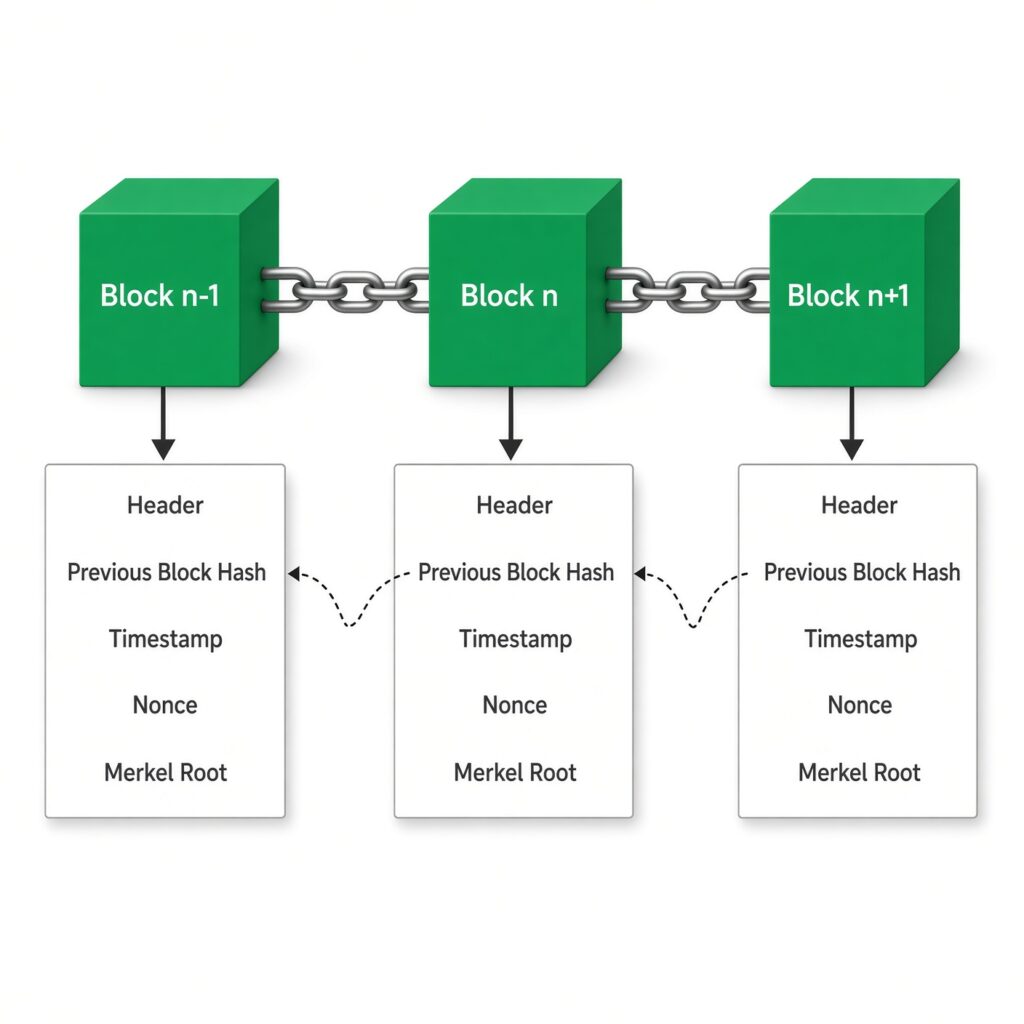
Every single block on a blockchain is more than just a list of transactions. It contains three critical structural components that ensure its security and integrity:
BLOCK DATA STRUCTURE:
- Transaction Details: Sender, Receiver, Amount
- Nonce: Number used once
- Hash of the Current Block
- Hash of the Previous Block
1. The Data
The actual information stored inside the block. For financial blockchains, this is a list of cryptocurrency transactions. For other industries, it could be medical codes, real estate titles, or supply chain tracking details.
2. The Nonce
A “nonce” is an abbreviation for “number used once.” It is a special random number generated during the block creation process. Miners or validators tweak this number continuously until they produce an acceptable cryptographic output that satisfies the network’s security requirements.
3. The Cryptographic Hash
A hash is like a digital fingerprint. It is a long string of letters and numbers created by running the block’s data through a mathematical algorithm. Every block has its own unique hash.
- Sensitivity: If even a single character inside the block changes—even a single digit in a transaction amount—the resulting hash changes completely.
- The Chain Link: Crucially, every block contains the hash of the previous block. This creates the unbreakable mathematical bond that ties the blocks together into a chain.
What Makes Blockchain Secure? Cryptography and Consensus
Security is the cornerstone of blockchain technology. Several advanced mechanisms work together to make tampering with a blockchain virtually impossible.
Cryptographic Hashing
Because each block contains the hash of the block before it, tampering with history is extremely difficult. If a malicious actor tries to alter a transaction in an old block, that block’s hash will immediately change. This mismatch will cause every subsequent block in the chain to become invalid, instantly alerting the network to the fraud.
Decentralization and Distributed Consensus
Even if a hacker successfully alters a block and recalculates all subsequent hashes on their own computer, they would still fail. Because the blockchain is distributed across thousands of independent nodes worldwide, the system compares the hacker’s altered ledger against the copies held by everyone else.
Since the vast majority of the network holds the correct, unaltered ledger, the fraudulent copy is automatically rejected. To successfully hack a blockchain, an attacker would need to control more than 50% of the entire network’s computing power simultaneously—a scenario known as a 51% attack, which is practically and economically impossible on major networks like Bitcoin.
Understanding Consensus Mechanisms: Proof of Work vs. Proof of Stake

How do all the computers in a decentralized network agree on which transactions are valid without a central authority? They use consensus mechanisms. The two most common protocols are:
Proof of Work (PoW)
Pioneered by Bitcoin, Proof of Work requires participating computers (called miners) to solve complex mathematical puzzles to validate transactions and create new blocks.
- The Process: This requires immense computational power and electricity.
- The Reward: The first miner to solve the puzzle is rewarded with newly minted cryptocurrency and transaction fees.
- The Trade-off: While extremely secure, PoW consumes significant amounts of energy.
Proof of Stake (PoS)
Used by newer networks like Ethereum, Proof of Stake replaces miners with validators. Instead of solving mathematical puzzles, validators lock up (or “stake”) a certain amount of their own cryptocurrency as collateral.
- The Process: The network randomly selects a validator to propose and verify the next block based on the size of their stake.
- The Reward: Successful validators earn transaction fees.
- The Trade-off: PoS is vastly more energy-efficient than Proof of Work, making it faster and more environmentally sustainable.
Types of Blockchains: Public, Private, and Consortium
Not all blockchains are built the same way. Depending on the use case, networks fall into three main categories:
| Blockchain Type | Access Level | Speed & Scalability | Primary Use Cases |
|---|---|---|---|
| Public Blockchain | Open to anyone; permissionless | Slower due to global decentralization | Cryptocurrencies (Bitcoin, Ethereum) |
| Private Blockchain | Restricted access; permissioned | Very fast and efficient | Internal enterprise auditing, corporate data management |
| Consortium Blockchain | Managed by a group of organizations | Balanced speed and control | Inter-bank settlements, supply chain collaboration |
Real-World Applications of Blockchain Beyond Cryptocurrency
While digital currencies grab the headlines, blockchain technology is quietly revolutionizing numerous industries by introducing transparency and trust.
1. Supply Chain and Logistics
Global supply chains are notoriously complex. Blockchain allows companies to track the exact journey of a product—from a farm in South America to a supermarket shelf in the United States—in real time. If food contamination occurs, authorities can pinpoint the exact source in seconds rather than weeks, saving lives and reducing waste.
2. Healthcare Data Management
Medical records are often fragmented across different hospitals and clinics, making secure sharing difficult. Blockchain enables patients to securely own and control their medical history. Doctors can access verified health records instantly while ensuring strict patient privacy and regulatory compliance.
3. Smart Contracts
Smart contracts are self-executing digital programs stored on a blockchain. The terms of the agreement are written directly into lines of code. Once predetermined conditions are met—such as a delivery arriving or a payment clearing—the contract automatically executes without requiring lawyers or escrow agents.
4. Digital Identity Protection
Identity theft is a massive global problem. Blockchain-based digital identity systems give individuals complete control over their personal information, allowing them to verify their identity securely online without sharing sensitive documents like Social Security numbers or passports unnecessarily.
Advantages and Limitations of Blockchain Technology

Like any technology, blockchain comes with a unique set of pros and cons that developers and businesses must weigh carefully.
The Advantages
- Enhanced Security: Cryptographic encryption and decentralization make data virtually unhackable.
- Transparency: Every transaction is recorded on a public or shared ledger, reducing fraud and corruption.
- Efficiency and Speed: By eliminating middlemen and manual paperwork, cross-border transactions and settlements happen in minutes instead of days.
- Lower Costs: Removing third-party intermediaries significantly reduces transaction and operational fees.
The Limitations
- Scalability Challenges: Public blockchains process transactions slower than centralized databases because every node must verify every action.
- High Energy Consumption: Traditional Proof of Work networks require substantial electrical power.
- Regulatory Uncertainty: Because blockchain operates globally and independently, governments worldwide are still figuring out how to regulate it effectively.
The Future of Trust and Transparency
Blockchain technology has evolved from a mysterious underground computing experiment into a foundational pillar of modern digital infrastructure. By replacing traditional, centralized authorities with transparent, decentralized mathematical trust, blockchain is redefining how we exchange value, secure data, and conduct business globally.
Whether you are an investor exploring the world of digital assets, a business owner looking to optimize your supply chain, or simply a curious digital citizen, understanding how blockchain works empowers you to navigate the future of technology with confidence. As adoption accelerates across industries, the impact of this revolutionary ledger will only continue to grow.